Today’s Industrial AI Daily Signal · Robotics · Shipbuilding
Shipyards turn robot deployment into a survival strategy.
Korean and Japanese shipbuilders are expanding production robotics as labor shortages and China’s 63% share of global ship orders turn smart-yard programs into an operating imperative.
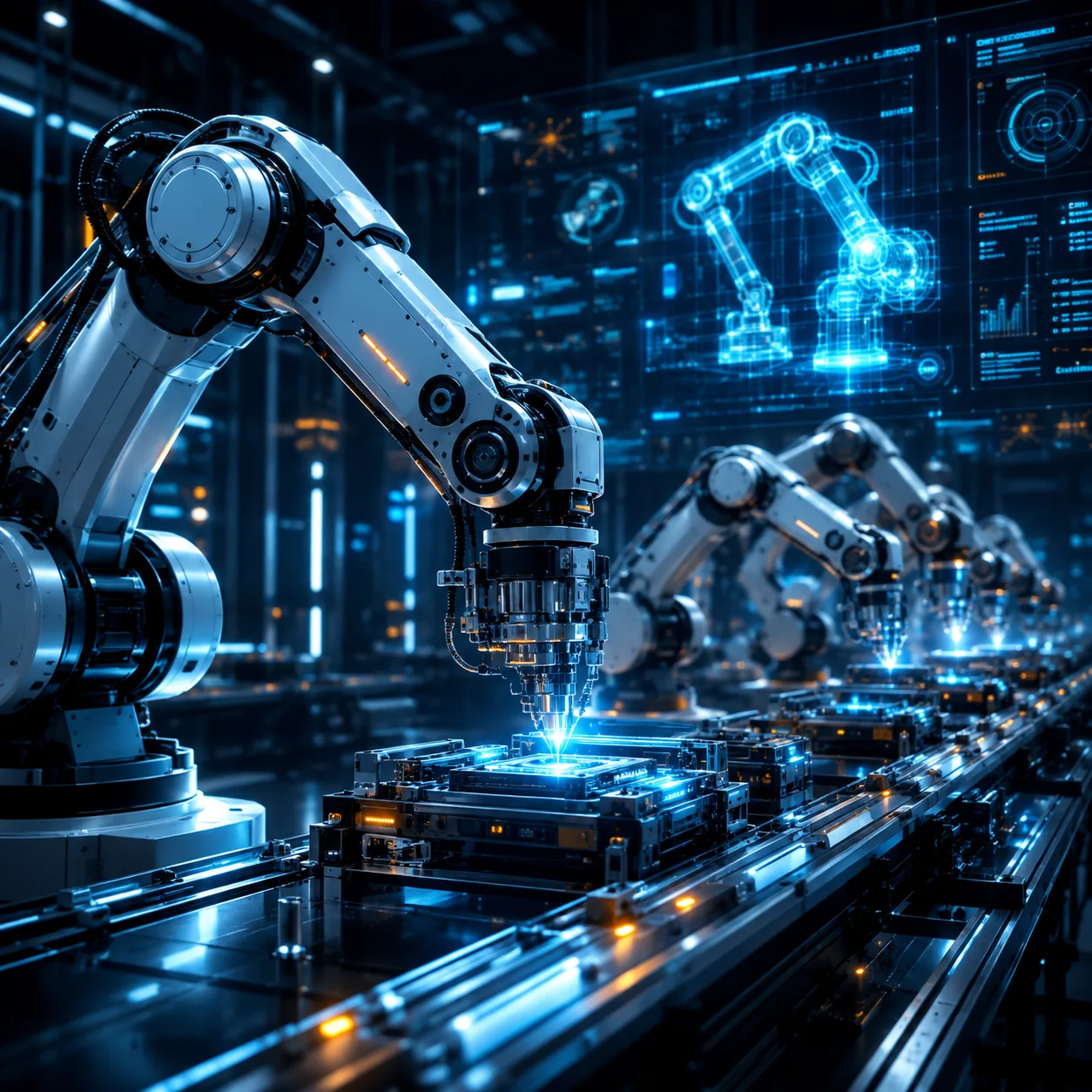
Financial Times reporting published October 4 describes Korean and Japanese yards deploying robots for welding, transport and other repetitive or hazardous work while China now accounts for 63% of global ship orders. HD Hyundai Samho says its competitiveness depends on multifunctional machines using artificial intelligence and autonomous technologies; HD Hyundai’s program also uses live digital twins to test production changes before they reach the yard.
HD Hyundai Robotics and HD Hyundai Samho had already formalized a production-automation and smart-factory program built around real-yard validation. The new evidence clarifies the competitive timetable: HD Hyundai aims to automate selected lines and create a small dark factory by 2030, while Hanwha Ocean—after investing 160 billion won in smart yards over two years—targets automation of 70% of production by 2030. The physical variability of large hulls still keeps dexterous work and exception recovery in human hands.
AI-assisted content may contain errors. Verify important facts and decisions against the linked original sources.
01
What changed
Smart-yard plans and individual welding robots were already known. What changed is the cross-company operating picture now visible: substantial current investment, robots moving into working yards, explicit 2030 automation targets and digital twins tied to physical production rather than design visualization alone.
02
Why it matters
Shipbuilding is one of manufacturing’s hardest automation environments: products are enormous, work changes by hull and many tasks occur in confined or hazardous spaces. A credible smart yard therefore requires perception, motion planning, production data and digital twins to operate as one system. Korea and Japan are now treating that integration as a response to labor scarcity and China’s scale, not as a technology showcase. Success could shorten lead times and stabilize quality across commercial vessels; failure would leave expensive robotic islands around a largely manual flow. The decisive evidence will be sustained throughput, rework, intervention and safety performance by process—not the percentage of equipment labeled automated.
03
What to watch
Watch which lines HD Hyundai automates first, Hanwha’s definition of 70% automation, robot utilization across complete shifts, weld-quality and rework rates, human interventions, safety incidents, schedule compression and evidence that digital-twin tests predict actual yard performance.
HD Hyundai Robotics documents the formal real-yard validation program and its intended expansion across shipbuilding affiliates. Financial Times reporting independently provides current deployment context, investment and 2030 targets across multiple Korean and Japanese operators. Process-level performance remains undisclosed.
Impact score
95/100
Reader reaction
How does this development make you feel?
Sources used for this edition
Behind today’s selection
Today’s two runners-up
Runner-up 1 · Computer Vision · Rail freight
Freight wagons gain in-motion AI inspection.
Project DRISHTI converts passing freight trains into digital inspection records, using high-speed cameras, controlled lighting and AI to flag open or partially secured wagon doors.
Why it was not selected: DRISHTI is a concrete operating deployment with a ten-month trial behind it, but its present footprint and measured error rates are not disclosed; the shipyard automation shift spans more processes, capital and operators.
View scoring details
- Industrial relevance
- 25/25
- Operational or economic impact
- 18/20
- Technology significance
- 13/15
- Evidence of real-world adoption
- 15/15
- Strategic significance
- 8/10
- Novelty
- 8/10
- Source confidence
- 5/5
- Source reliability
- 30/30
- Independent corroboration
- 22/25
- Primary or official evidence
- 24/25
- Evidence consistency
- 19/20
Runner-up 2 · Smart Infrastructure · Industrial power
Permian gas processing moves 230 megawatts behind the meter.
Long-term contracts will place roughly 230 megawatts of generation beside Targa’s Permian gas-processing operations, with full deployment expected in early 2028.
Why it was not selected: The signed capacity is large and operationally concrete, but deployment is still prospective and the announcement provides no telemetry, efficiency, emissions or uptime design; the two higher-ranked stories already place intelligence into live production and inspection workflows.
View scoring details
- Industrial relevance
- 24/25
- Operational or economic impact
- 19/20
- Technology significance
- 11/15
- Evidence of real-world adoption
- 13/15
- Strategic significance
- 8/10
- Novelty
- 6/10
- Source confidence
- 5/5
- Source reliability
- 30/30
- Independent corroboration
- 21/25
- Primary or official evidence
- 24/25
- Evidence consistency
- 19/20