Advanced Industrial AI
Deep Learning & Computer Vision
Learning complex patterns from images and sensor data
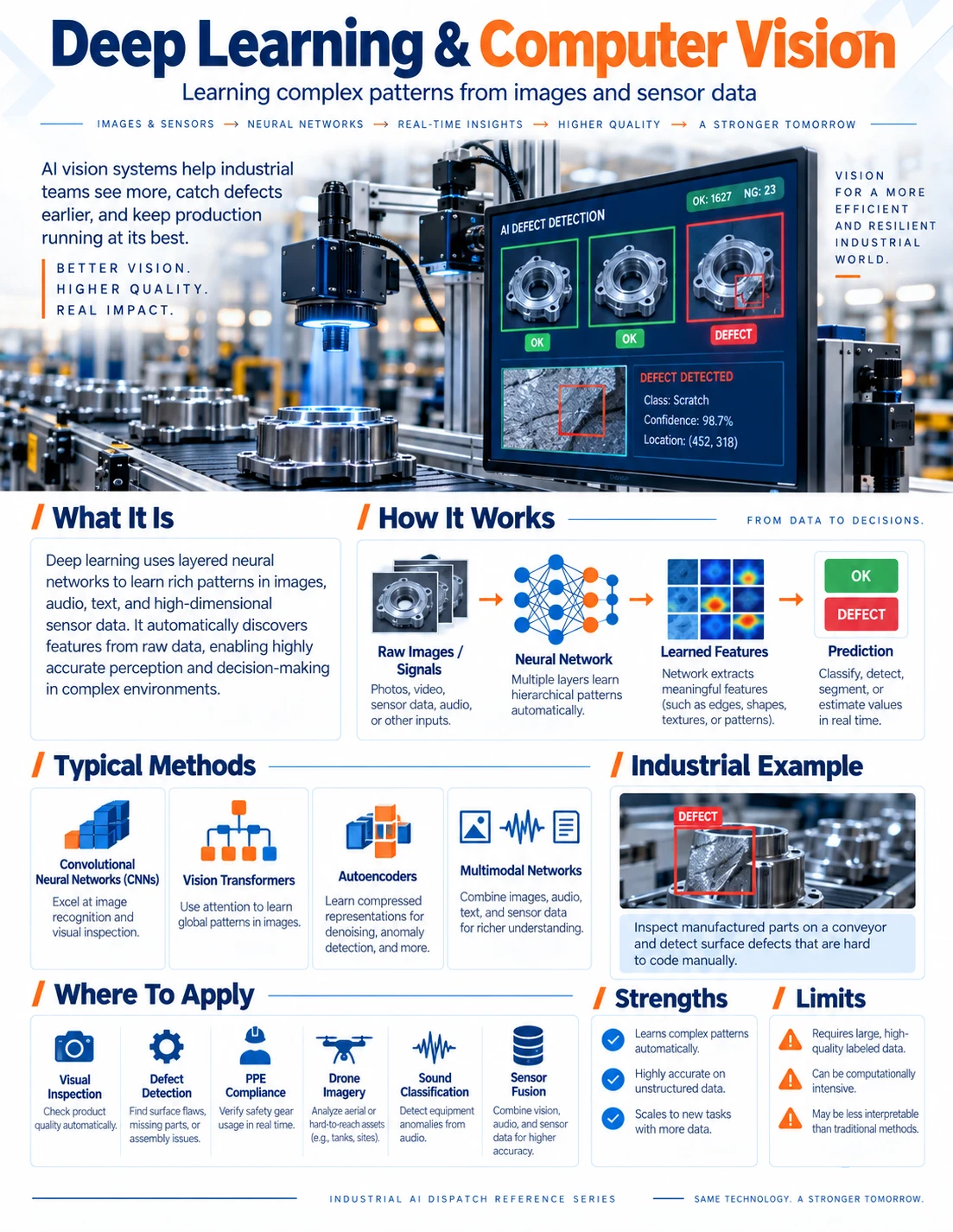
Overview
Deep learning uses multi-layer neural networks to learn rich patterns automatically from large datasets. Computer vision is one of its most visible industrial uses, enabling machines to inspect parts, read scenes, monitor safety, and understand visual context.
How It Works
- Collect images, video, audio, or high-dimensional sensor data.
- Use a deep neural architecture that can learn features automatically.
- Train the network on labeled tasks such as detection, classification, or segmentation.
- Deploy the trained model for real-time or batch inference.
- Monitor drift, retrain as needed, and integrate results into quality or operations workflows.
Typical Algorithms or Techniques
- Convolutional Neural Networks (CNNs)
- Vision Transformers
- Autoencoders
- Multimodal Networks
- Segmentation models
Industrial Applications
- Visual inspection
- Defect detection
- PPE compliance
- Drone imagery analysis
- Sensor fusion
Industrial Example
Inspect machined parts on a conveyor and detect subtle surface defects that are difficult to code manually with rules.
Illustrative scenario; performance depends on the data, operating conditions, and validation.
Strengths
- Learns complex patterns automatically.
- High accuracy on image-heavy and unstructured problems.
- Scales well when data volume is strong.
Limitations
- Needs substantial data and compute.
- Can be less interpretable than simpler models.
- Model monitoring and retraining are often essential.
Frequently Asked Questions
What is deep learning?
Deep learning uses multi-layer neural networks to learn rich patterns automatically from large datasets.
What is computer vision used for in industry?
Computer vision is used for defect detection, inspection, PPE monitoring, scene understanding, automation, and drone-based analysis.
Why use deep learning instead of simpler models?
Deep learning is especially useful when the data is complex and unstructured, such as images, video, audio, or high-dimensional signals.
What is the main trade-off with deep learning?
It often needs more data, more compute, and stronger model governance than simpler approaches.
Related Algorithms
Explore Industrial Applications
See how these technologies connect to physical assets in the Industrial Equipment Atlas, or follow the Daily Signal for industrial AI developments.