Advanced Industrial AI
Reinforcement Learning
Learning better actions through reward and feedback
Overview
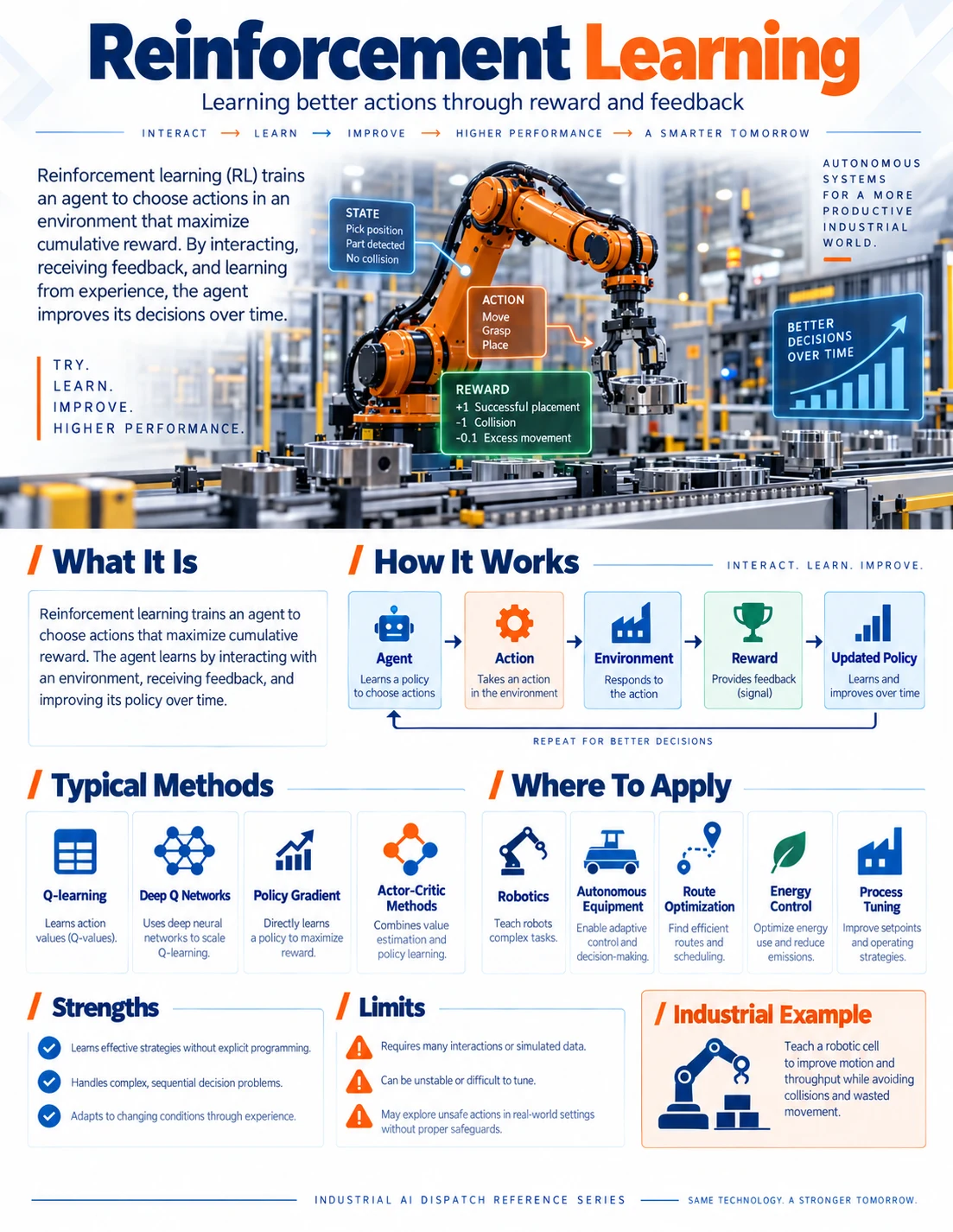
Reinforcement learning trains an agent to choose actions that maximize cumulative reward. Instead of learning from a static labeled dataset alone, the system improves through interaction, experimentation, and feedback.
How It Works
- Define an environment, a set of possible actions, and a reward signal.
- Let the agent observe the current state.
- Have the agent choose an action based on its policy.
- Measure the reward and the next state produced by that action.
- Update the policy so future decisions become more effective over time.
Typical Algorithms or Techniques
- Q-learning
- Deep Q Networks
- Policy Gradient
- Actor-Critic methods
- Model-based RL
Industrial Applications
- Robotics
- Autonomous equipment
- Route optimization
- Energy control
- Process tuning
Industrial Example
Teach a robotic cell to improve motion and throughput while avoiding collisions, wasted movement, and unstable behavior.
Illustrative scenario; performance depends on the data, operating conditions, and validation.
Strengths
- Good for sequential decision-making.
- Can learn strategies beyond manually coded rules.
- Adapts through feedback and interaction.
Limitations
- Needs many interactions or high-quality simulation.
- Can be difficult to tune and validate.
- Unsafe exploration must be controlled carefully in real-world operations.
Frequently Asked Questions
What is reinforcement learning?
Reinforcement learning trains an agent to choose actions that maximize cumulative reward through interaction and feedback.
Where is reinforcement learning useful in industry?
It is useful in robotics, autonomous equipment, route optimization, process tuning, and energy control.
How is reinforcement learning different from supervised learning?
Supervised learning learns from fixed labeled examples. Reinforcement learning learns through trial, reward, and sequential decision-making.
What is the biggest challenge with reinforcement learning?
The biggest challenge is safely learning effective behavior, often requiring simulation, careful tuning, and strict operational safeguards.
Related Algorithms
Explore Industrial Applications
See how these technologies connect to physical assets in the Industrial Equipment Atlas, or follow the Daily Signal for industrial AI developments.