Industrial Automation · Equipment Atlas
Industrial Robot Arms
Programmable multi-axis manipulators that weld, assemble, handle, paint, inspect, and machine with repeatable motion.
- Industry
- Manufacturing · Automotive · Electronics · Logistics
- Primary applications
- Welding · Material handling · Assembly
- Key technologies
- Robotics · Computer Vision · AI · Digital Twins
01
What is it?
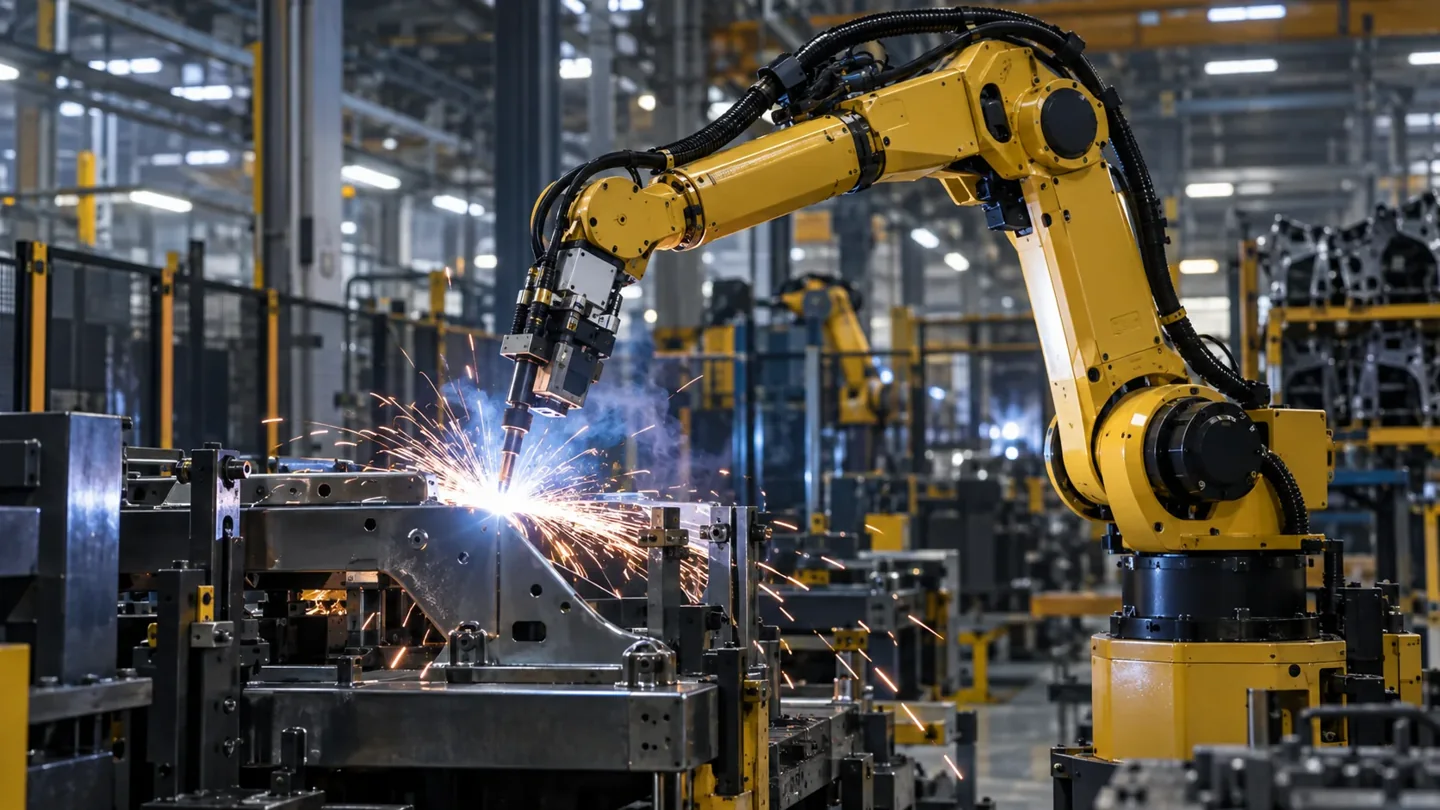
An industrial robot arm is a programmable chain of rigid links and powered joints. It positions a tool—such as a welder, gripper, sprayer, spindle, or camera—along a repeatable path.
Traditional industrial robots work inside guarded cells at high speed. Collaborative robots use force and power limits, safety-rated monitoring, and application-specific risk controls to work closer to people.
02
Typical applications
- Welding
- Material handling
- Assembly
- Painting
- Machine tending
- Inspection
03
How it works
A controller converts the programmed tool path into coordinated joint motion. Sensors report joint position and status while the end effector interacts with the part and surrounding fixtures.
Engineers teach points manually, import paths from engineering software, or use vision and force feedback to adapt the motion. The surrounding cell—fixtures, conveyors, guarding, tooling, and quality checks—is as important as the arm.
04
Why it matters
Robot arms make high-volume production more repeatable and remove people from hot, sharp, toxic, heavy, or monotonous work. They also underpin flexible automation when tooling and software can change with the product.
A robot’s business value depends on uptime, changeover, part presentation, quality, and integration—not simply rated speed or payload.
Equipment class—not a single model
Key specifications
Ranges are representative. Actual values vary by manufacturer, configuration, duty cycle, market, and model generation.
Representative—not exhaustive
Major manufacturers
- ABB
- FANUC
- KUKA
- Yaskawa Motoman
- Kawasaki Robotics
- Universal Robots
The Industrial AI Dispatch lens
How AI is changing this equipment
Vision-guided manipulation
AI perception lets robots locate less-structured parts, estimate pose, inspect surfaces, and respond to variation.
Learning from demonstration
Operators can show a task through guided motion, video, or teleoperation rather than programming every step.
Simulation and digital twins
Virtual cells test reach, collisions, throughput, and controls before equipment is installed or production is interrupted.
Adaptive quality
Force, current, acoustic, and visual signals can adjust a process and detect defects during the operation instead of afterward.