Today’s Industrial AI Daily Signal · Smart infrastructure · AI data centers
Google made Finland’s nuclear lifetime part of its AI build.
Google committed €13 billion to Finnish AI infrastructure and signed a 22-year power deal supporting the Loviisa nuclear plant through 2050. The package combines data centers, grid siting, wind contracts and a 94-megawatt battery.
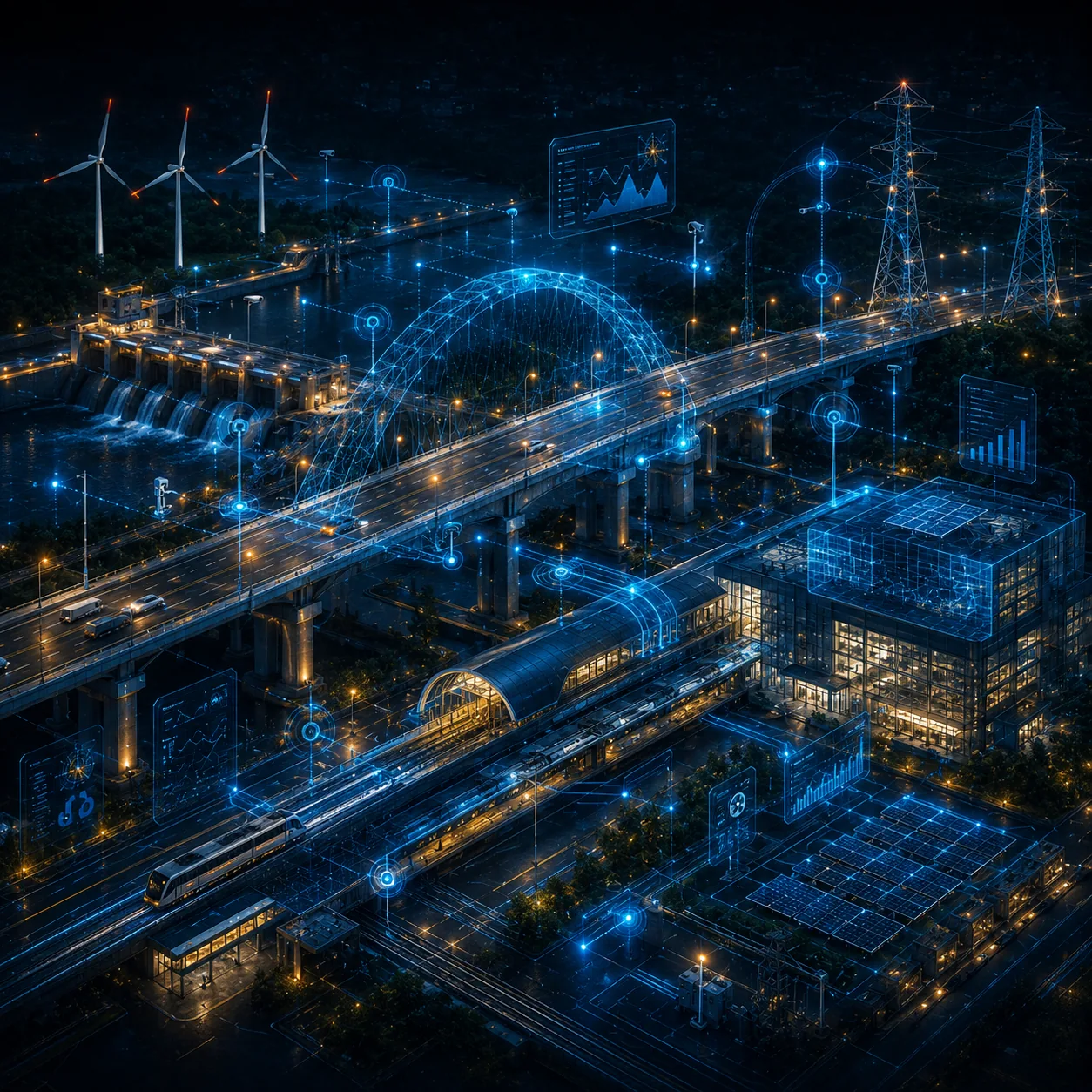
Google will invest at least €13 billion during 2027 and 2028 in data centers and supporting infrastructure across Hamina, Kajaani, Muhos and Vaala. It is the company’s largest single investment in Europe. Google says the construction phase will support an average of 37,000 jobs nationally, while the operating facilities and their suppliers are projected to support 7,000 jobs a year.
The industrial shift is in the power package. A 22-year agreement with Fortum provides revenue certainty for the Loviisa nuclear plant’s life-extension program, preserving a station that supplies about 10% of Finland’s electricity and could not continue beyond 2030 without further investment. Google also contracted additional wind generation and a 94 MW battery, selected northern sites near available low-carbon power and plans to explore demand response and possible new reactors with Fortum.
AI-assisted content may contain errors. Verify important facts and decisions against the linked original sources.
01
What changed
Yesterday’s edition covered a 900 MW contracted AI-factory platform in Asia-Pacific. Today’s development is different and materially larger: Google has committed €13 billion to named Finnish regions and coupled the build to a signed, 22-year agreement supporting the life extension of an existing national nuclear asset.
02
Why it matters
AI infrastructure is becoming an anchor customer for entire energy systems. Google is not simply adding servers to Finland: its long-duration demand is helping preserve a nuclear plant that supplies roughly one-tenth of the country’s electricity, while the same expansion supports wind, batteries, grid planning and possible future reactors. That structure gives data-center growth consequences for household prices, industrial power availability, construction, network investment and national energy security. It also establishes a model other markets may copy when compute demand exceeds what existing grids can absorb: pair new load with specific long-lived generation and flexibility rather than treating electricity as an unlimited input.
03
What to watch
Watch local permits, grid-connection agreements, construction starts in the four municipalities, Fortum’s remaining Loviisa investment decisions and the battery’s planned late-2027 commissioning. The decisive test is whether new compute capacity and matching power assets arrive on schedule without raising costs for other Finnish users.
Google and Fortum provide primary evidence for the investment, power agreement and energy package, while Reuters independently confirms the scale, 22-year term and nuclear-life-extension rationale. Confidence is exceptionally high in the signed commitments; individual data-center capacities, final permits and construction schedules remain undisclosed.
Impact score
95/100
Reader reaction
How does this development make you feel?
Sources used for this edition
Behind today’s selection
Today’s two runners-up
Runner-up 1 · Autonomous mobility · Maritime operations
Iran’s capture exposed the logic of attritable underwater autonomy.
Iran captured a U.S. Dive-LD autonomous underwater vehicle after the Pentagon says it malfunctioned while surveying regional waters. Anduril described the loss as an expected risk for a system designed to operate without sailors in dangerous environments.
Why it was not selected: The captured vehicle reveals an important operating model, but one failed mission has far narrower economic reach than Google’s national-scale infrastructure and power commitment.
View scoring details
- Industrial relevance
- 20/25
- Operational or economic impact
- 14/20
- Technology significance
- 14/15
- Evidence of real-world adoption
- 14/15
- Strategic significance
- 9/10
- Novelty
- 3/10
- Source confidence
- 4/5
- Source reliability
- 30/30
- Independent corroboration
- 24/25
- Primary or official evidence
- 20/25
- Evidence consistency
- 18/20
Runner-up 2 · Industrial automation · Equipment manufacturing
Epiroc put every breaker size inside one automated factory.
Epiroc opened a highly automated and scalable factory in Kalmar, Sweden, producing its complete hydraulic-breaker range. The site consolidates equipment for construction, demolition, quarrying, mining and infrastructure customers.
Why it was not selected: The operating factory is tangible adoption, but Epiroc disclosed no investment, capacity or productivity metrics comparable with Google’s €13 billion system build.
View scoring details
- Industrial relevance
- 23/25
- Operational or economic impact
- 12/20
- Technology significance
- 9/15
- Evidence of real-world adoption
- 13/15
- Strategic significance
- 6/10
- Novelty
- 1/10
- Source confidence
- 4/5
- Source reliability
- 28/30
- Independent corroboration
- 14/25
- Primary or official evidence
- 23/25
- Evidence consistency
- 17/20