Industrial Automation · Equipment Atlas
Autonomous Mobile Robots (AMRs)
Self-navigating vehicles that move materials through factories and warehouses without fixed guide paths.
- Industry
- Manufacturing · Warehousing · Logistics
- Primary applications
- Line-side delivery · Pallet transport · Work-in-process movement
- Key technologies
- Autonomous Systems · Robotics · Computer Vision · IoT
01
What is it?
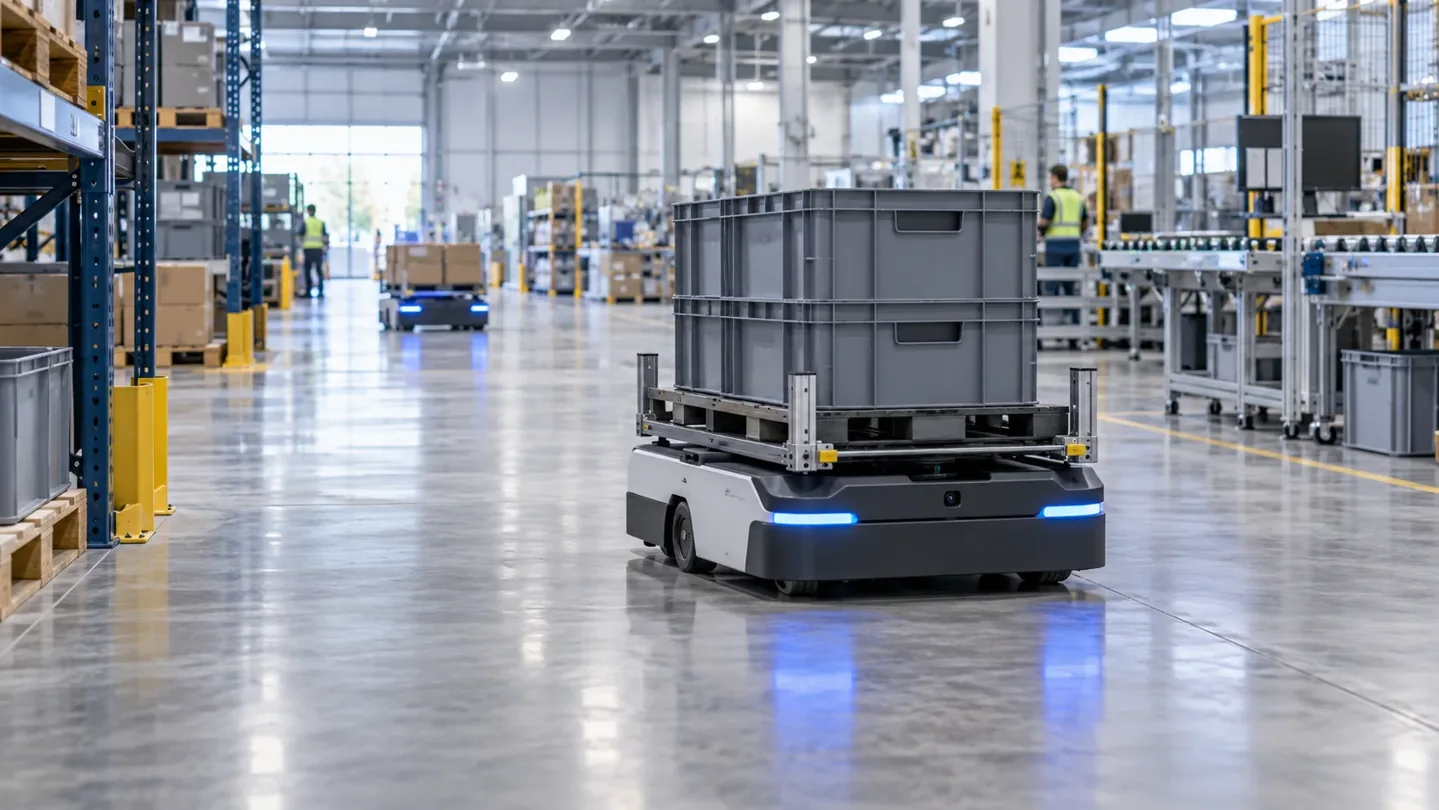
An autonomous mobile robot moves loads through a facility while localizing itself and planning routes around people, vehicles, and changing obstacles. Unlike traditional automated guided vehicles, most AMRs do not require a buried wire, magnetic tape, or a permanently fixed path.
The robot is usually a mobile base combined with a top module such as a shelf lift, conveyor, pallet lifter, cart hitch, or robot arm.
02
Typical applications
- Line-side delivery
- Pallet transport
- Work-in-process movement
- Warehouse replenishment
- Machine tending
03
How it works
A warehouse, manufacturing, or fleet system assigns a mission. The robot plans a route, yields or reroutes around traffic, docks at a station, transfers or presents the load, and proceeds to its next job or charger.
Lidar, cameras, encoders, inertial sensors, and safety scanners support localization and obstacle detection. Fleet software manages traffic, priorities, charging, zones, and handoffs with production equipment.
04
Why it matters
AMRs automate material movement without rebuilding the entire facility. That makes them attractive for brownfield plants where product mix and routes change.
The difficult part is often integration rather than navigation: missions must match production schedules, doors, elevators, conveyors, workers, containers, and exception procedures.
Equipment class—not a single model
Key specifications
Ranges are representative. Actual values vary by manufacturer, configuration, duty cycle, market, and model generation.
Representative—not exhaustive
Major manufacturers
- Mobile Industrial Robots
- OTTO Motors
- OMRON
- KUKA
- Seegrid
- Zebra Technologies
The Industrial AI Dispatch lens
How AI is changing this equipment
More adaptive navigation
Learning-based perception improves classification of people, forklifts, pallets, free space, and unusual obstacles.
Fleet orchestration
Optimization software assigns work across mixed robot fleets while balancing congestion, priorities, batteries, and station availability.
Workflow learning
Operational data reveals bottlenecks, repeated exceptions, empty travel, poor layouts, and opportunities to redesign material flow.
Mobile manipulation
Combining an AMR with a robot arm extends automation from transport into picking, machine tending, and inspection.