Construction · Equipment Atlas
Motor Graders
Precision earthmoving machines whose long, adjustable moldboard creates and maintains controlled surfaces.
- Industry
- Construction · Mining · Infrastructure
- Primary applications
- Road construction · Finish grading · Haul-road maintenance
- Key technologies
- Machine Control · IoT · Computer Vision · Optimization
01
What is it?
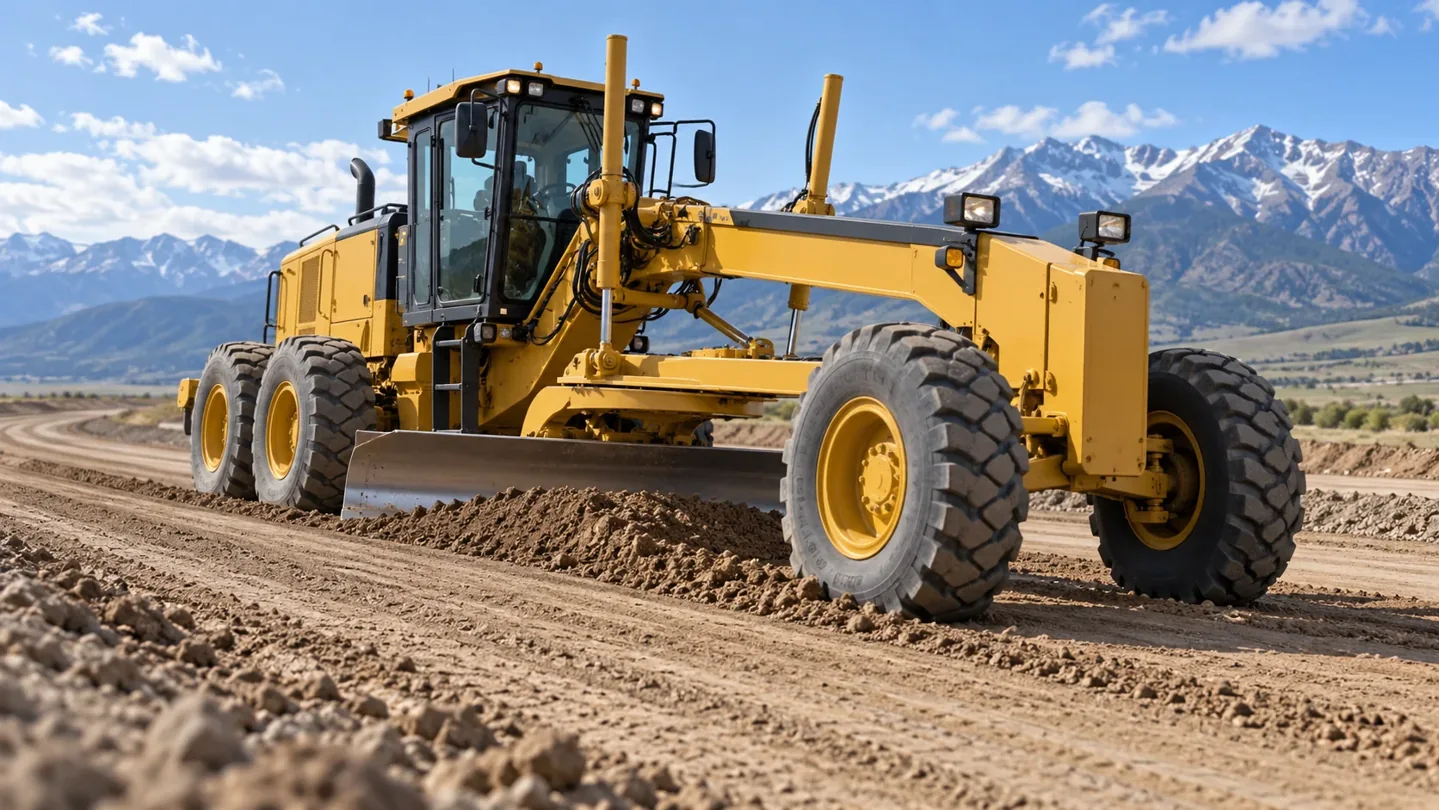
A motor grader places a long blade between its front and rear axles, giving the cutting edge stability and a wide range of motion. It trims high points, fills low points, shapes crowns and slopes, and controls drainage.
Graders are finishing machines, but in mines they also preserve haul-road quality. Smooth, correctly drained roads allow trucks to travel faster while reducing tire, suspension, and frame damage.
02
Typical applications
- Road construction
- Finish grading
- Haul-road maintenance
- Drainage shaping
- Snow removal
03
How it works
The operator steers the articulated chassis and continuously adjusts blade lift, angle, side shift, pitch, and circle rotation. Tandem rear axles provide traction while the leaning front wheels counter side forces.
Several light passes usually produce a better surface than one aggressive cut. Machine-control systems compare the blade with a digital model and guide or automate corrections.
04
Why it matters
Final grade determines whether a road, pad, or drainage surface performs as designed. In mining, road condition is also a fleet productivity variable rather than cosmetic maintenance.
Because grading relies heavily on operator judgment, assistive control can shorten training, reduce rework, and make results more consistent.
Equipment class—not a single model
Key specifications
Ranges are representative. Actual values vary by manufacturer, configuration, duty cycle, market, and model generation.
Representative—not exhaustive
Major manufacturers
- Caterpillar
- Komatsu
- John Deere
- Volvo Construction Equipment
- SANY
The Industrial AI Dispatch lens
How AI is changing this equipment
Cross-slope and grade automation
Control systems hold target slope or blade elevation, reducing repetitive manual corrections.
Road-condition sensing
Machine motion, cameras, and fleet telemetry can identify roughness, potholes, drainage problems, and priority maintenance zones.
Digital work plans
Design surfaces and progress data connect the grader to survey, construction-management, and mine-planning workflows.
Operator coaching
Cycle and control data can reveal inefficient passes, excessive wheel slip, and blade settings that increase fuel or rework.
Technical references