Machine Learning Foundations
Time-Series Forecasting
Predicting what happens next over time
Overview
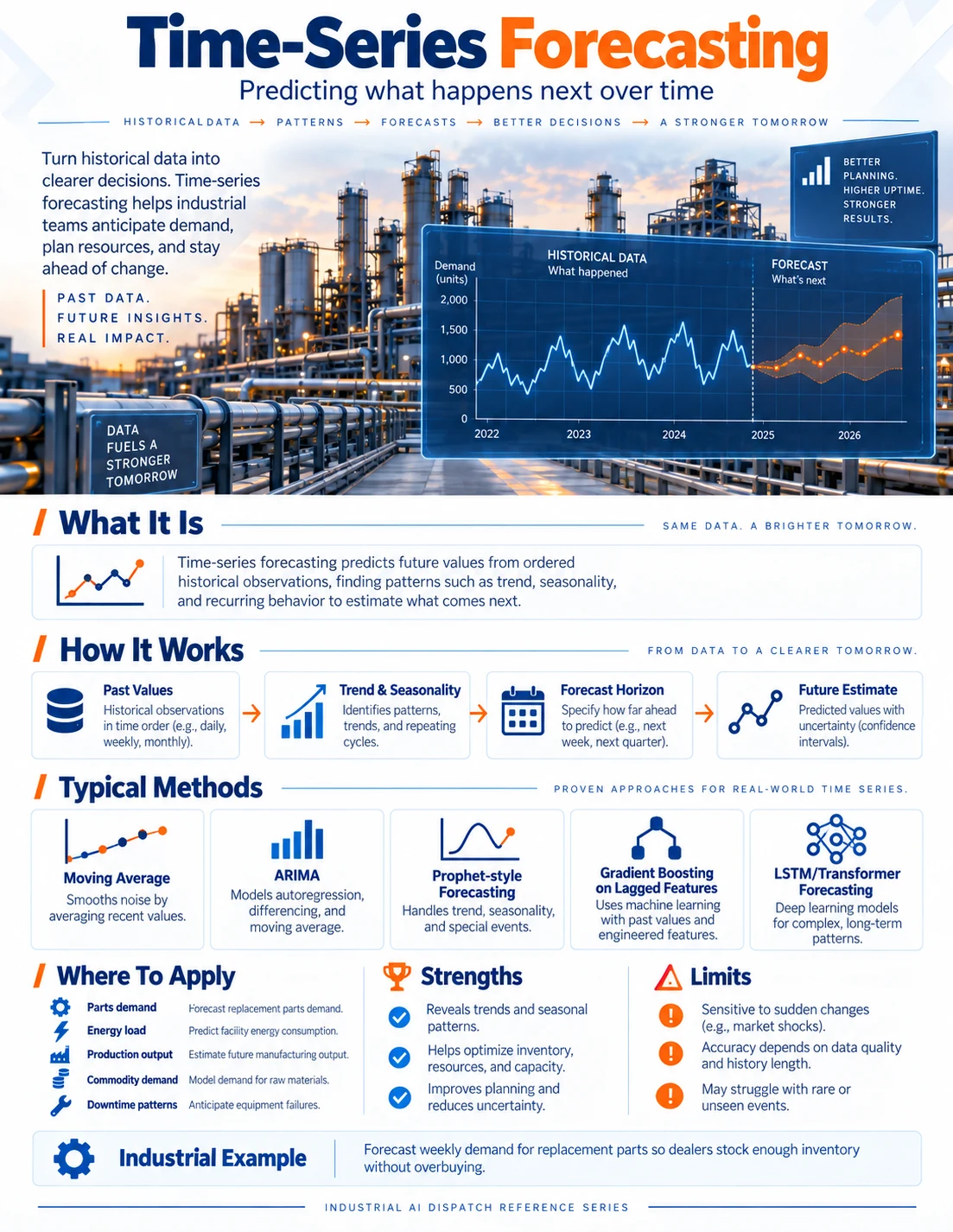
Time-series forecasting predicts future values from ordered historical observations. It is especially useful when patterns depend on time, trend, seasonality, business cycles, or lagged behavior.
How It Works
- Collect time-stamped historical observations.
- Analyze patterns such as trend, seasonality, cycles, and volatility.
- Select a forecast horizon such as next day, next week, or next quarter.
- Fit a model using historical sequences or lagged features.
- Generate a forecast and, ideally, a confidence range for likely outcomes.
Typical Algorithms or Techniques
- Moving Average
- ARIMA
- Prophet-style models
- Gradient Boosting on lagged features
- LSTM / Transformer forecasting
Industrial Applications
- Parts demand forecasting
- Energy load prediction
- Production output planning
- Commodity demand
- Downtime pattern forecasting
Industrial Example
Forecast weekly demand for replacement parts so dealers carry enough inventory without overstocking.
Illustrative scenario; performance depends on the data, operating conditions, and validation.
Strengths
- Reveals trend and seasonal structure.
- Supports capacity, inventory, and workforce planning.
- Can reduce uncertainty when timing matters.
Limitations
- Sensitive to sudden structural breaks.
- Forecast quality depends on data history and signal stability.
- Rare one-off events are hard to predict.
Frequently Asked Questions
What is time-series forecasting?
Time-series forecasting predicts future values from historical observations arranged in time order.
What problems is time-series forecasting used for in industry?
It is used for parts demand, energy load, output planning, commodity demand, and other situations where timing and sequence matter.
How is time-series forecasting different from ordinary regression?
Time-series forecasting explicitly models order, trend, seasonality, cycles, and lagged behavior over time.
What methods are common for industrial forecasting?
Common methods include ARIMA, moving averages, Prophet-style approaches, lagged-feature machine learning, and deep learning sequence models.
Related Algorithms
Explore Industrial Applications
See how these technologies connect to physical assets in the Industrial Equipment Atlas, or follow the Daily Signal for industrial AI developments.