Mining · Equipment Atlas
Ultra-Class Mining Haul Trucks
The largest rigid-frame trucks in surface mining, built to move hundreds of tons of ore or waste on every cycle.
- Industry
- Mining
- Primary applications
- Open-pit mining · Overburden removal · Ore transport
- Key technologies
- Autonomous Systems · IoT · Computer Vision · Predictive Maintenance
01
What is it?
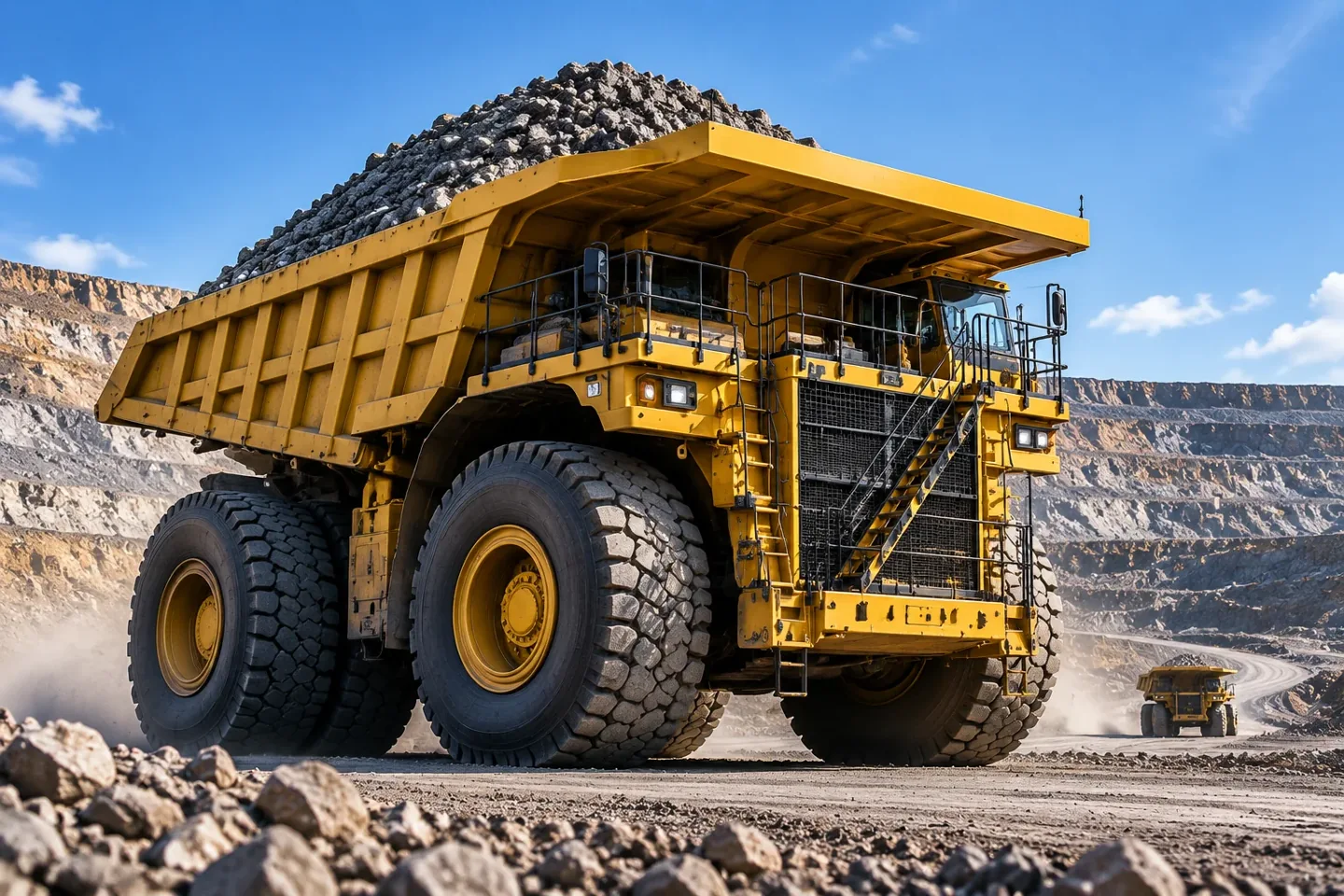
Ultra-class haul trucks are rigid-frame vehicles generally defined by payload ratings of roughly 300 short tons or more. They carry blasted rock from a loading face to a crusher, stockpile, or waste dump, repeating the same routes around the clock.
They exist because moving material is one of a surface mine’s largest operating costs. A truck must combine extreme payload, braking and cooling capacity with predictable cycle times on steep, dusty haul roads.
Fun fact: the tires on the largest LMT are roughly 13 feet (4 meters) in diameter.
02
Typical applications
- Open-pit mining
- Overburden removal
- Ore transport
- Quarrying
03
How it works
A shovel or large excavator loads the body in several passes. The truck follows a dispatch assignment, climbs or descends the haul route, queues at its destination, tips the body, and returns empty.
Diesel-electric models use an engine-generator set to power wheel motors; mechanical-drive models transmit power through a gearbox and final drives. Operators—or an autonomous haulage system—coordinate speed, spacing, right of way, loading position, and dumping.
Fun fact: The Cat 797F carries a nominal 400-ton (US) payload. Caterpillar describes its six tires as roughly 13 feet (4 meters) in diameter. Source: Caterpillar’s 797F description.
At the Caterpillar Visitors Center in Peoria, Illinois, visitors can experience a virtual ride in the bed of a large Cat 797F display. The center’s current exhibit description does not describe it as an operational truck.
04
Why it matters
Truck availability and cycle time directly constrain mine throughput. Small changes in queuing, spotting, road condition, or payload consistency compound across a fleet of dozens or hundreds of machines.
Automation can remove people from collision, rollover, fatigue, dust, and vibration exposure, but it also makes communications, road design, fleet orchestration, and recovery procedures more important.
Equipment class—not a single model
Key specifications
Ranges are representative. Actual values vary by manufacturer, configuration, duty cycle, market, and model generation.
Representative—not exhaustive
Major manufacturers
- Caterpillar
- Komatsu
- Liebherr
- Hitachi Construction Machinery
- BELAZ
The Industrial AI Dispatch lens
How AI is changing this equipment
Autonomous haulage
Perception, localization, dispatch, and supervisory software allow trucks to run without an onboard driver inside controlled mine zones.
Fleet optimization
Dispatch systems balance trucks, loading tools, crushers, queues, road congestion, and shift targets rather than optimizing one vehicle at a time.
Connected condition monitoring
Telemetry supports payload control, tire management, fuel and energy analysis, component health models, and planned maintenance.
Electrification
Trolley assist, battery systems, dynamic charging, and energy-aware routing are being developed to reduce diesel use without sacrificing production.
Technical references