Construction · Equipment Atlas
Wheel Loaders
Fast, versatile loading machines that scoop, carry, stockpile, and feed material across mines, quarries, plants, and jobsites.
- Industry
- Construction · Mining · Manufacturing · Energy
- Primary applications
- Truck loading · Stockpile management · Quarrying
- Key technologies
- IoT · Payload Sensing · Computer Vision · Predictive Maintenance
01
What is it?
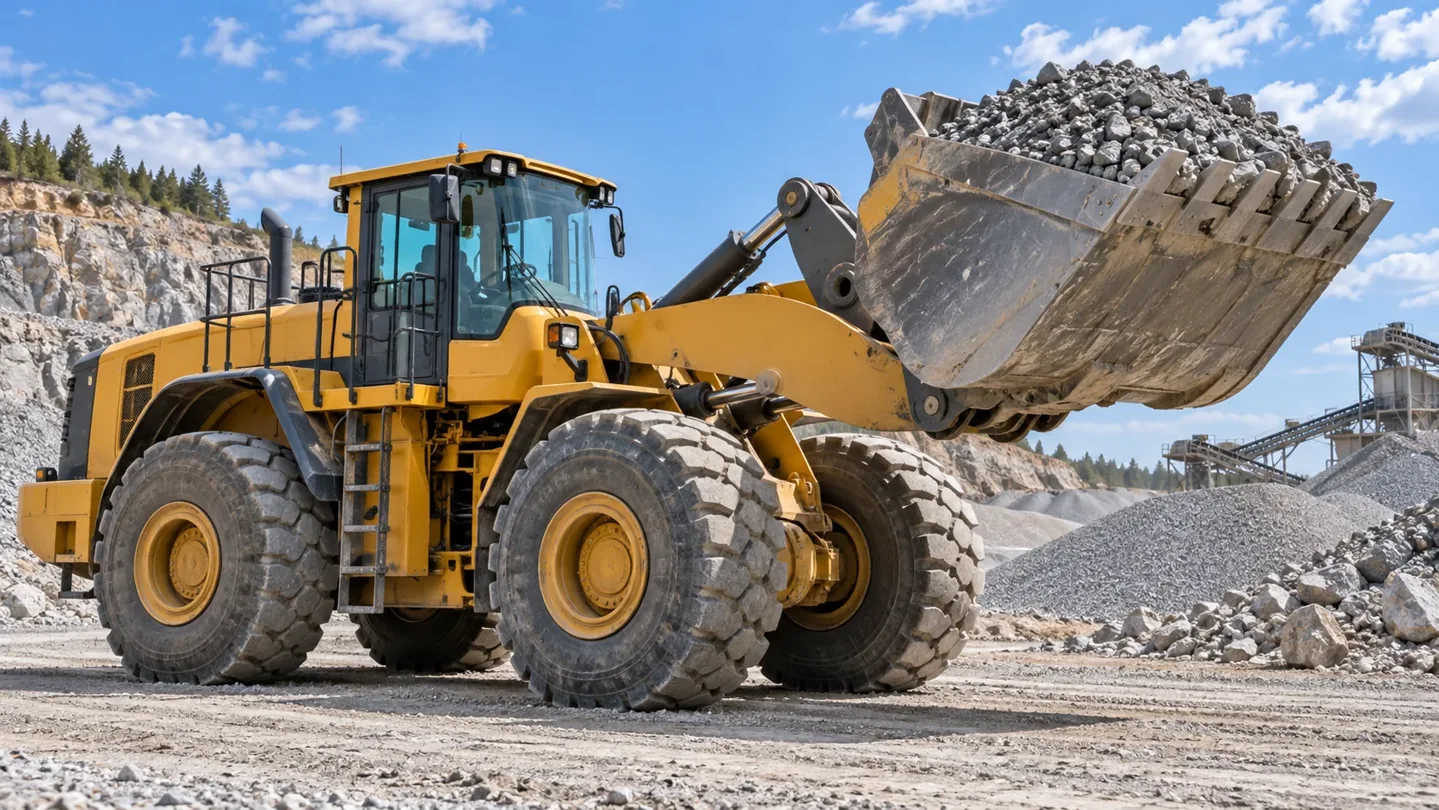
A wheel loader combines an articulated wheeled chassis with lift arms and a front bucket or work tool. It loads trucks, reclaims stockpiles, feeds crushers and hoppers, and carries material over short distances.
Its advantage is mobility and attachment versatility. The same carrier can work with buckets, forks, grapples, couplers, and specialized tools across many industries.
02
Typical applications
- Truck loading
- Stockpile management
- Quarrying
- Material handling
- Plant feeding
03
How it works
In a typical loading cycle, the machine approaches the pile, fills the bucket, reverses while lifting, turns toward the truck or hopper, dumps, and returns. The shortest safe path and a clean pile face are central to productivity.
Articulated steering keeps the bucket aligned with the front frame. Modern machines coordinate engine, transmission, hydraulics, traction control, and payload measurement during each cycle.
04
Why it matters
Wheel loaders often connect storage piles with the next production process. If the loader falls behind, crushers, plants, trucks, or customers wait.
Their varied duty cycles make right-sizing, operator behavior, bucket selection, tire management, and idle reduction major cost levers.
Equipment class—not a single model
Key specifications
Ranges are representative. Actual values vary by manufacturer, configuration, duty cycle, market, and model generation.
Representative—not exhaustive
Major manufacturers
- Caterpillar
- Komatsu
- Volvo Construction Equipment
- Liebherr
- John Deere
- Hitachi Construction Machinery
The Industrial AI Dispatch lens
How AI is changing this equipment
Payload intelligence
Onboard weighing and material recognition improve truck loading accuracy, inventory records, and production reporting.
Assisted loading
Automatic dig, lift, tilt, and return-to-position functions reduce repetitive control work and variation between operators.
Vision and proximity
Cameras, radar, and object detection help address blind spots around a frequently reversing machine.
Energy optimization
Cycle analytics, idle reduction, hybrid systems, and battery-electric designs target one of the most variable energy profiles in mobile equipment.
Technical references