Mining · Equipment Atlas
Electric Rope Shovels
High-volume loading machines that use electric motors, wire ropes, and a rigid dipper to fill mine haul trucks.
- Industry
- Mining
- Primary applications
- Open-pit mining · Overburden loading · Ore loading
- Key technologies
- IoT · Predictive Maintenance · Computer Vision · Optimization
01
What is it?
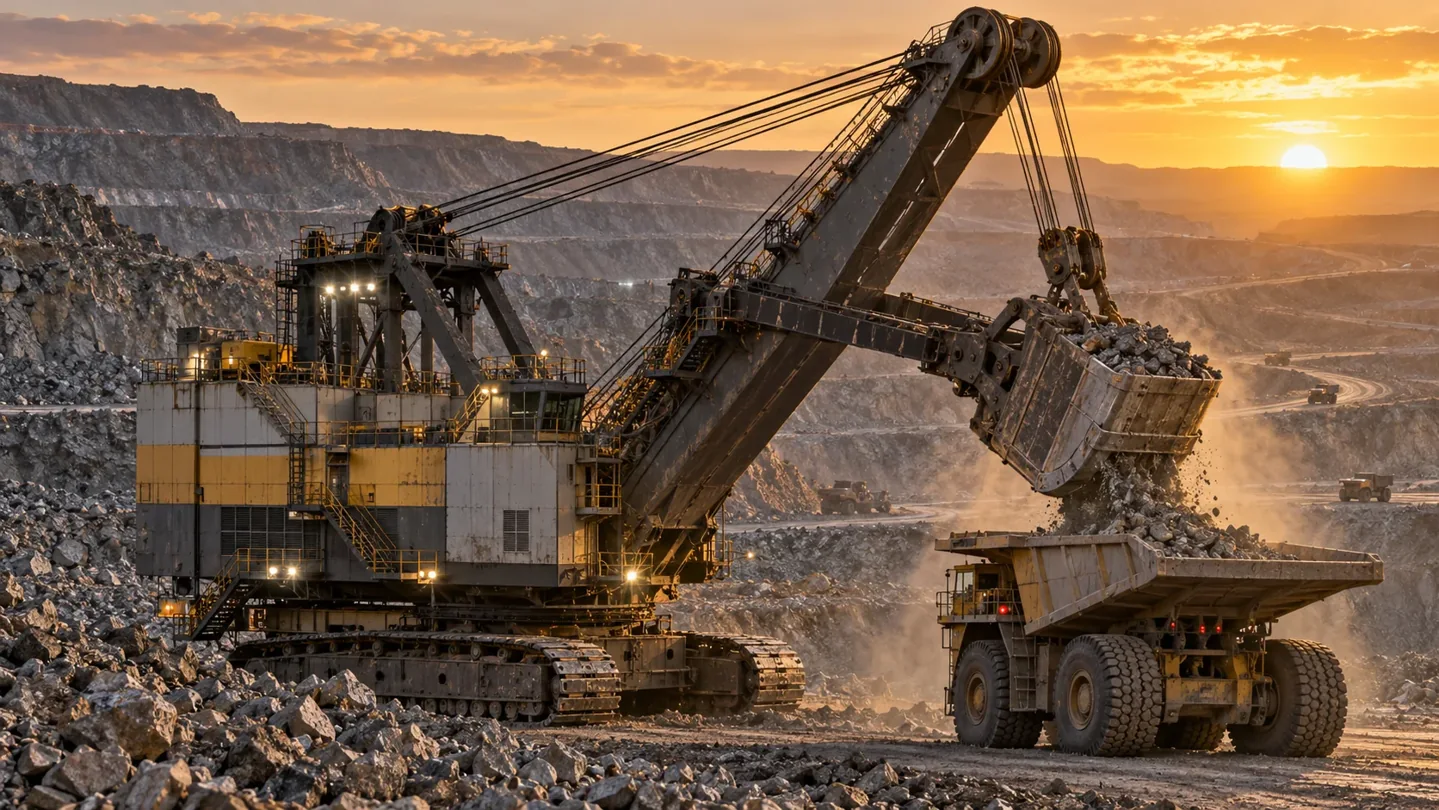
An electric rope shovel is a large, electrically powered excavator designed to load fragmented rock quickly and repeatedly. A rigid dipper is pushed into the bank by a crowd mechanism and raised by hoist ropes.
Rope shovels are used where production volume, long service life, and low cost per ton matter more than mobility. They typically remain in one mining area while haul trucks cycle around them.
02
Typical applications
- Open-pit mining
- Overburden loading
- Ore loading
- Large-scale excavation
03
How it works
The operator positions the crawler-mounted machine beside the digging face. Crowd force drives the dipper into broken material; hoist ropes lift it; the upper structure swings toward a truck; and the dipper door releases the load.
The machine connects to the mine’s electrical distribution system through a trailing cable. Productive operation depends on clean digging geometry, consistent fragmentation, truck spotting, and coordinated swing paths.
04
Why it matters
A rope shovel can set the production pace for an entire truck fleet. Its long life and high loading rate make it one of the defining capital assets of a large surface mine.
Electric power eliminates onboard diesel combustion, but the cable, substation capacity, and mine plan become part of the machine’s operating system.
Equipment class—not a single model
Key specifications
Ranges are representative. Actual values vary by manufacturer, configuration, duty cycle, market, and model generation.
Representative—not exhaustive
Major manufacturers
- Caterpillar
- Komatsu P&H
- Taiyuan Heavy Industry
- OMZ
The Industrial AI Dispatch lens
How AI is changing this equipment
Operator assistance
Dig limits, anti-swing logic, collision awareness, and camera systems help operators protect the machine and load trucks consistently.
Payload and fragmentation analytics
Sensors and vision estimate bucket fill, truck payload distribution, and material characteristics at the face.
Predictive maintenance
Models combine motor current, vibration, temperature, lubrication, and cycle data to identify deterioration in hoist, crowd, swing, and structural systems.
Loading optimization
Mine planning and dispatch data can align shovel production with truck arrivals, crusher demand, ore grade, and energy constraints.