Construction · Equipment Atlas
Bulldozers
Tracked machines that push, rip, spread, and grade material where traction and ground control matter most.
- Industry
- Construction · Mining · Energy
- Primary applications
- Earthmoving · Site preparation · Mine support
- Key technologies
- Machine Control · Autonomous Systems · IoT · Computer Vision
01
What is it?
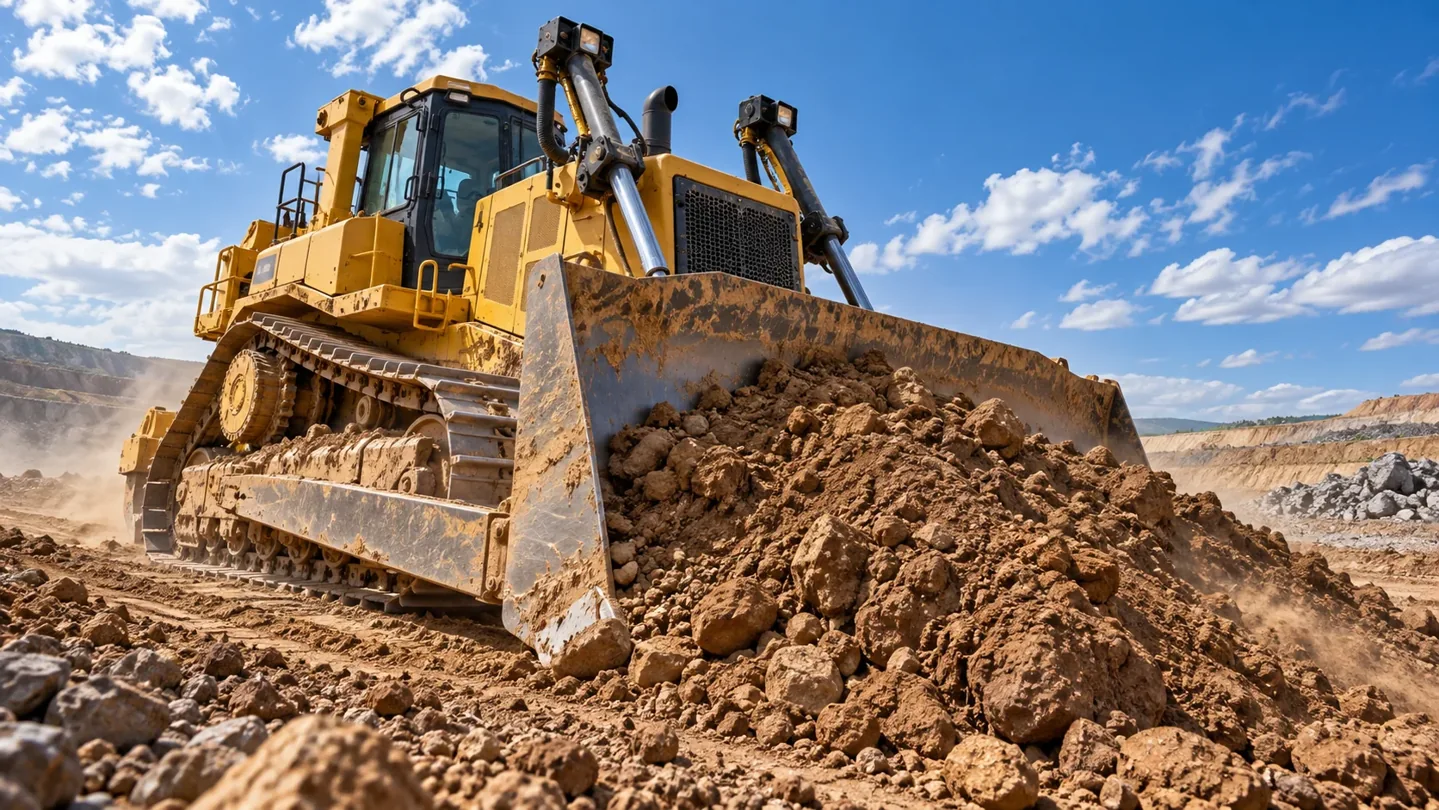
A bulldozer is a high-traction tractor equipped with a front blade and often a rear ripper. Its tracks spread weight over a large contact area, allowing it to work on soft, steep, or broken ground.
Dozers shape terrain rather than carry material long distances. They clear sites, build pads and roads, maintain mine dumps, push stockpiles, and break hard ground before excavation.
02
Typical applications
- Earthmoving
- Site preparation
- Mine support
- Land clearing
- Road building
03
How it works
The operator sets blade angle, tilt, and height while controlling travel and track steering. Material rolls ahead of the blade during the push and is spread or placed at the end of the pass.
Modern hydrostatic or powershift drivetrains provide fine control at low speed. Grade-control systems can automatically adjust the blade to a digital design.
04
Why it matters
Dozers prepare the working surface for almost every other mobile machine. Poor grading affects drainage, haul-road speed, tire life, machine stability, and the quality of finished construction.
Remote and autonomous operation are particularly valuable on unstable stockpiles, steep slopes, contaminated sites, and active mining areas.
Equipment class—not a single model
Key specifications
Ranges are representative. Actual values vary by manufacturer, configuration, duty cycle, market, and model generation.
Representative—not exhaustive
Major manufacturers
- Caterpillar
- Komatsu
- Liebherr
- John Deere
- Shantui
The Industrial AI Dispatch lens
How AI is changing this equipment
Automated grading
GNSS, inertial sensors, and 3D designs can control blade elevation and slope while the operator manages travel.
Remote and autonomous dozing
Teleoperation and supervised autonomy remove operators from unstable or hazardous material.
Terrain intelligence
Machine data updates progress maps, cut-and-fill quantities, compaction assumptions, and road condition.
Condition analytics
Track wear, drivetrain load, fuel use, temperature, and fault histories support maintenance and operating decisions.
Technical references