Mining · Equipment Atlas
Hydraulic Mining Excavators
Large, flexible digging machines that use hydraulic cylinders to load rock, shape benches, and work selective mining faces.
- Industry
- Mining
- Primary applications
- Open-pit mining · Selective excavation · Truck loading
- Key technologies
- IoT · Predictive Maintenance · Computer Vision · Digital Twins
01
What is it?
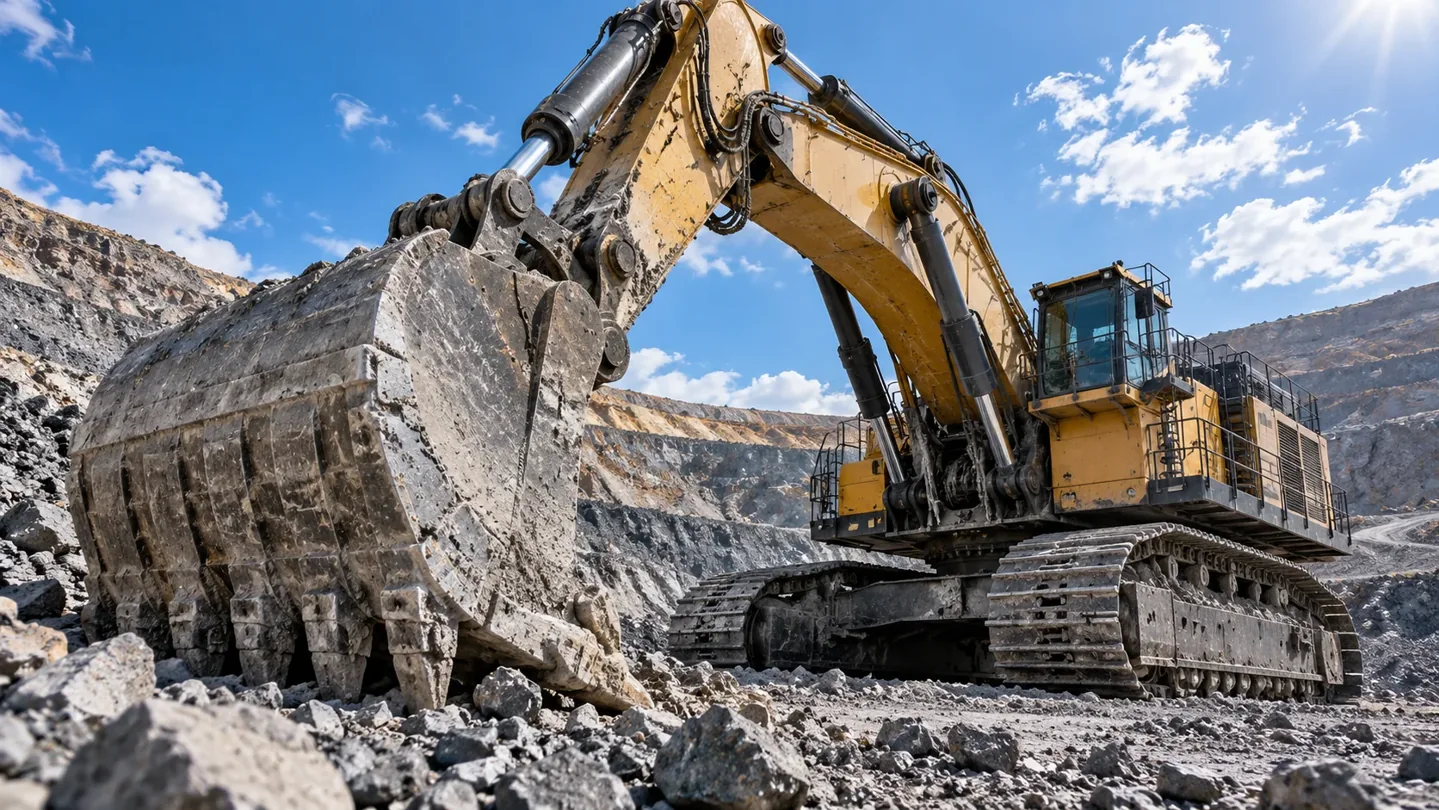
Hydraulic mining excavators are the largest members of the excavator family. Pumps send pressurized fluid to cylinders and motors that move the boom, stick, bucket, swing system, and tracks.
Compared with rope shovels, they are easier to reposition and can work in tighter or more selective digging conditions. Front-shovel configurations attack the face above track level; backhoe configurations dig below it.
02
Typical applications
- Open-pit mining
- Selective excavation
- Truck loading
- Quarrying
- Bench development
03
How it works
The machine digs, lifts, swings, dumps into a truck, and returns to the face. Hydraulic control gives the operator independent, proportional movement of several functions at once.
Production depends on bucket selection, fragmentation, bench geometry, truck match, operator technique, and thermal management. Large units may use diesel engines or a direct electric supply.
04
Why it matters
Hydraulic machines give mines production capacity without committing to the fixed operating pattern of a rope shovel. They can change faces, clean floors, handle oversize material, and support selective ore control.
Their many high-pressure components create rich condition data—and expensive failure modes—making them strong candidates for predictive maintenance.
Equipment class—not a single model
Key specifications
Ranges are representative. Actual values vary by manufacturer, configuration, duty cycle, market, and model generation.
Representative—not exhaustive
Major manufacturers
- Caterpillar
- Komatsu
- Liebherr
- Hitachi Construction Machinery
- SANY
The Industrial AI Dispatch lens
How AI is changing this equipment
Machine guidance
Digital terrain models, GNSS, and bucket-position sensing show operators the design surface and reduce rework.
Vision-assisted loading
Cameras can improve truck spotting, detect people or obstacles, and estimate bucket fill and fragmentation.
Hydraulic health analytics
Pressure, temperature, contamination, and cycle signatures help predict pump, cylinder, valve, and attachment problems.
Digital twins
Physics and data-driven models can compare expected and actual loading cycles, structural stress, fuel use, and component life.