Machine Learning Foundations
Classification
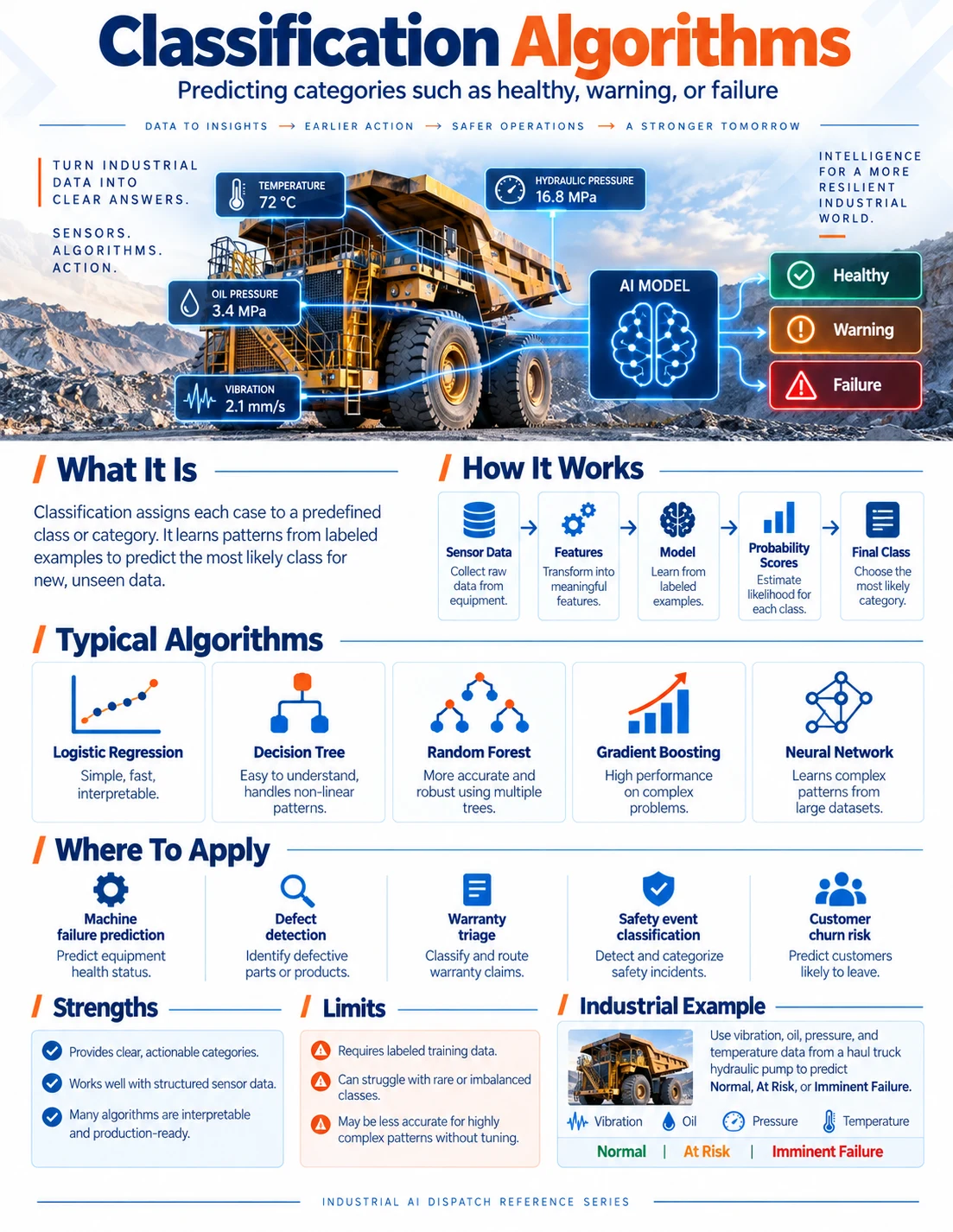
Predicting categories such as healthy, warning, or failure
Overview
Classification is a supervised learning task that assigns each case to one of several predefined categories. It is often used when industrial teams need a clear decision or status level rather than a numeric forecast.
How It Works
- Collect labeled examples for each class, such as normal, warning, and failure.
- Create features from sensor, process, image, or document data.
- Train a classifier to estimate the likelihood of each possible class.
- Set decision thresholds and business rules.
- Use the output to trigger alerts, routing, or downstream actions.
Typical Algorithms or Techniques
- Logistic Regression
- Decision Tree
- Random Forest
- XGBoost / Gradient Boosting
- Neural Networks
Industrial Applications
- Machine failure prediction
- Defect detection
- Warranty triage
- Safety event categorization
- Customer churn risk
Industrial Example
Use vibration, oil pressure, and temperature data from a haul truck to classify the machine state as Normal, At Risk, or Imminent Failure.
Illustrative scenario; performance depends on the data, operating conditions, and validation.
Strengths
- Produces clear, actionable categories.
- Many models are interpretable and production-ready.
- Useful when the business process needs a yes/no or tiered decision.
Limitations
- Needs labeled training data.
- Can struggle with rare or highly imbalanced classes.
- Threshold choices affect false alarms vs. missed detections.
Frequently Asked Questions
What is classification in industrial AI?
Classification assigns each case to a predefined category, such as healthy, warning, failure, pass, fail, or high-risk.
How is classification used in predictive maintenance?
A classifier can analyze telemetry and operating conditions to estimate whether equipment is healthy or likely to fail soon.
What is the difference between classification and regression?
Classification predicts a category, while regression predicts a number. For example, classification may predict failure risk, while regression may estimate 300 hours remaining.
Which classification algorithms are common in industry?
Common choices include logistic regression, decision trees, random forests, gradient boosting, and neural networks.
Related Algorithms
Explore Industrial Applications
See how these technologies connect to physical assets in the Industrial Equipment Atlas, or follow the Daily Signal for industrial AI developments.