Infrastructure · Equipment Atlas
Tunnel Boring Machines
Underground factories that excavate, remove spoil, support the ground, and often build the tunnel lining in one continuous process.
- Industry
- Infrastructure · Construction · Mining · Energy
- Primary applications
- Metro tunnels · Rail and road tunnels · Water conveyance
- Key technologies
- Automation · IoT · Digital Twins · Computer Vision
01
What is it?
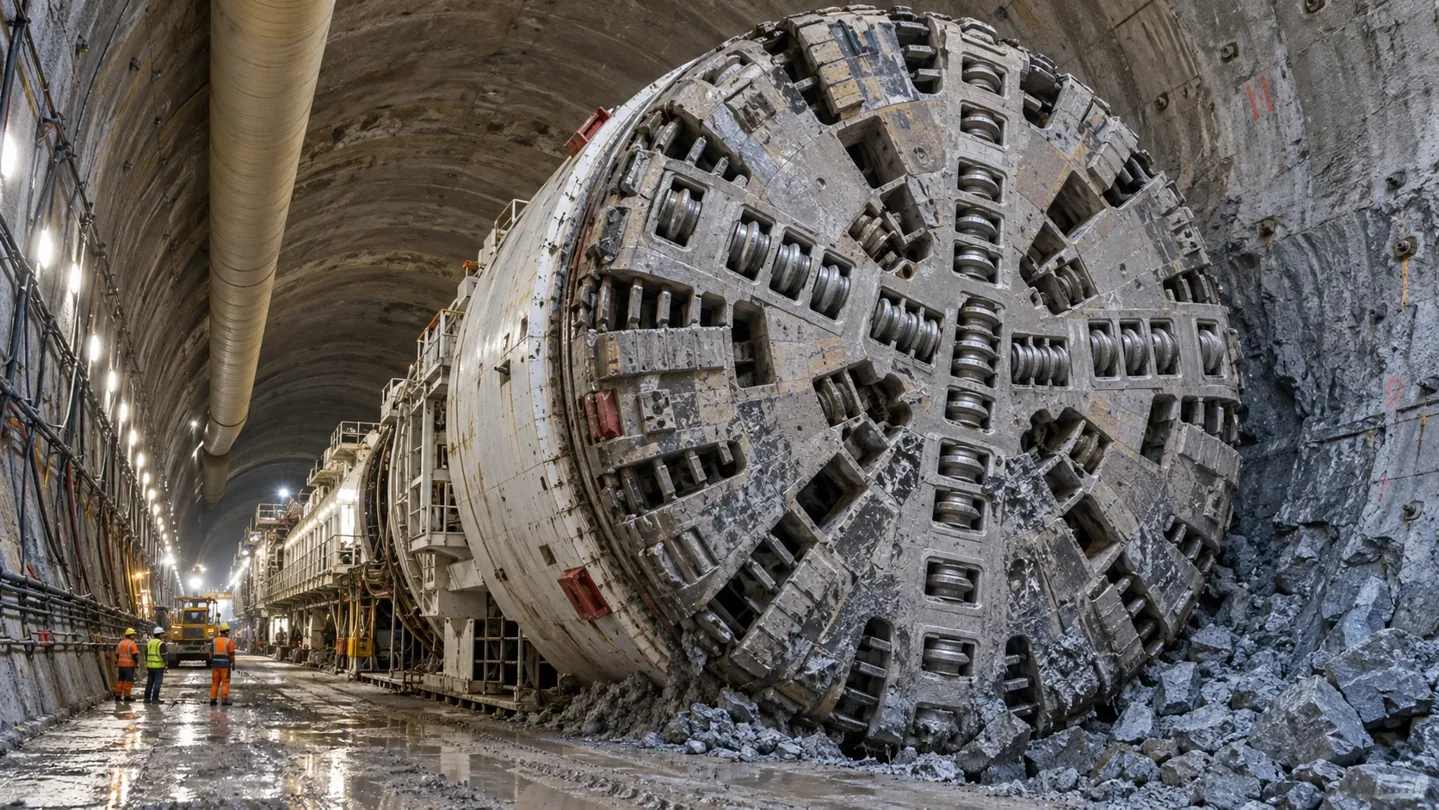
A tunnel boring machine excavates a circular tunnel with a rotating cutterhead. Behind it, a long backup system carries conveyors, pumps, power, ventilation, controls, and lining equipment.
Different ground conditions require different machines. Open hard-rock TBMs rely on rock stability and grippers; earth-pressure-balance and slurry shields control unstable ground and groundwater pressure at the face.
02
Typical applications
- Metro tunnels
- Rail and road tunnels
- Water conveyance
- Sewer tunnels
- Utility and energy tunnels
03
How it works
Cutters break or shear the face as hydraulic thrust cylinders advance the machine. Excavated material passes through openings in the cutterhead to a screw conveyor, slurry circuit, or belt system.
Shielded machines commonly erect precast concrete lining segments behind the cutterhead. Survey and guidance systems continuously control alignment, while crews service cutters and manage ground conditioning, logistics, and spoil removal.
04
Why it matters
TBMs make long underground infrastructure possible beneath dense cities, mountains, rivers, and environmentally sensitive areas with less surface disruption than open excavation.
The machine is only one part of a tightly coupled production system. Ground uncertainty, cutter wear, spoil handling, segment supply, and intervention time determine progress and risk.
Equipment class—not a single model
Key specifications
Ranges are representative. Actual values vary by manufacturer, configuration, duty cycle, market, and model generation.
Representative—not exhaustive
Major manufacturers
- Herrenknecht
- Robbins
- China Railway Construction Heavy Industry
- China Railway Engineering Equipment Group
- Kawasaki Heavy Industries
The Industrial AI Dispatch lens
How AI is changing this equipment
Geology-aware control
Models combine torque, thrust, penetration, vibration, pressure, and spoil data to infer changing ground conditions ahead of direct observation.
Performance optimization
Decision support balances penetration rate against cutter wear, face stability, energy use, and material-removal capacity.
Automated guidance
Survey integration and closed-loop steering keep a machine on alignment over long underground drives.
Digital project twins
Machine, geology, lining, logistics, and schedule data can be joined to forecast progress and evaluate intervention risk.