Mining · Equipment Atlas
Dragline Excavators
Long-reach excavators that cast and drag a suspended bucket to remove enormous volumes of overburden.
- Industry
- Mining · Energy
- Primary applications
- Overburden removal · Surface coal mining · Large earthmoving
- Key technologies
- IoT · Predictive Maintenance · Digital Twins · Optimization
01
What is it?
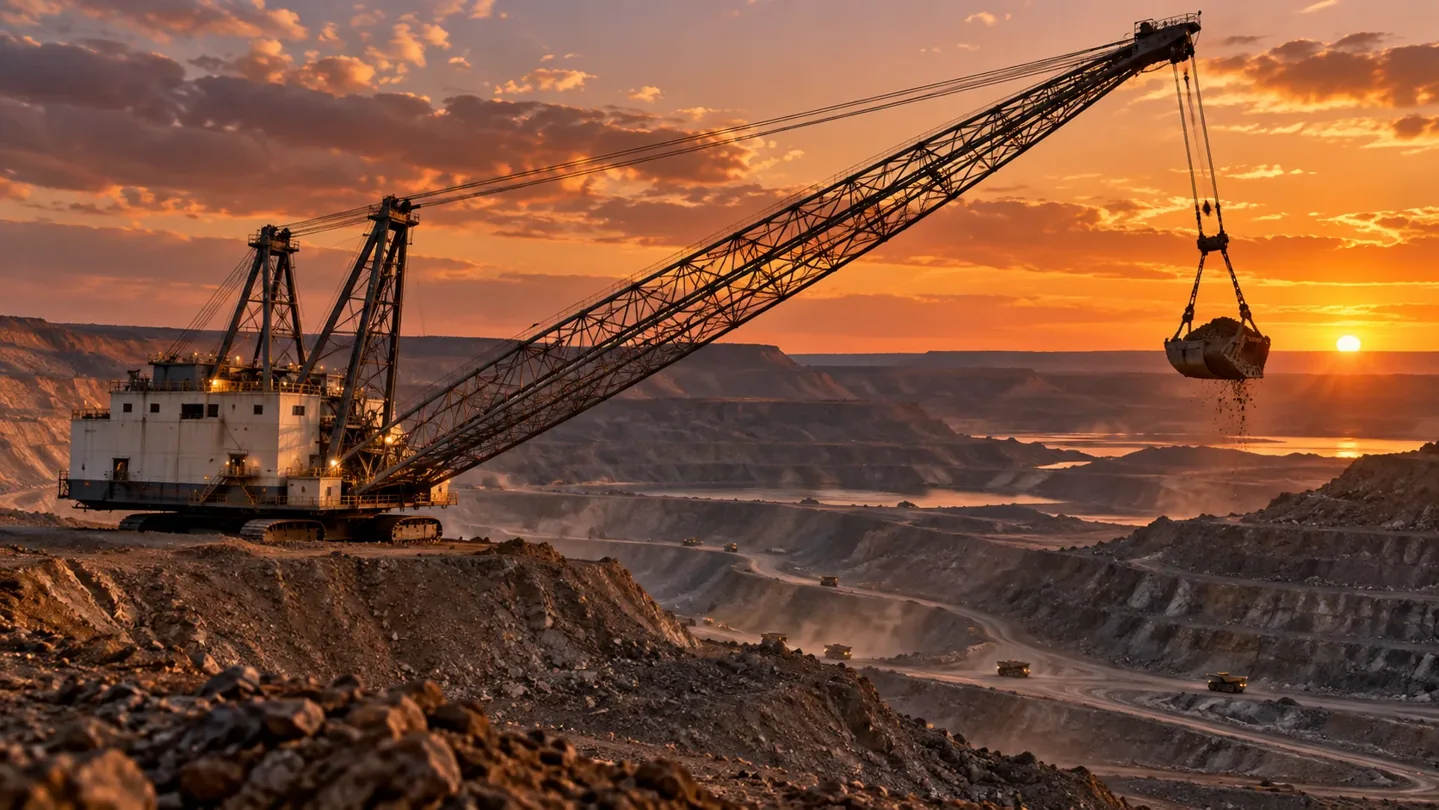
A dragline suspends its bucket from a long lattice boom using hoist and drag ropes. Rather than pushing a rigid attachment into the ground, it casts or lowers the bucket, drags it through the material, then lifts and swings the load to the dump point.
The largest walking draglines are effectively movable industrial structures. Mines use them to uncover coal or other deposits because one machine can shift huge volumes without a truck fleet for every pass.
02
Typical applications
- Overburden removal
- Surface coal mining
- Large earthmoving
- Mine reclamation
03
How it works
The bucket is positioned away from the machine, pulled through the bank, hoisted clear, swung across the pit, and emptied. The operator coordinates rope motion, swing, bucket attitude, and dump placement through each cycle.
Walking draglines periodically lift and step their base to relocate. Moves are slow and planned; the working radius and spoil geometry are central to the mine plan.
04
Why it matters
A single dragline can replace a large amount of truck-and-shovel overburden movement. Its productivity shapes stripping cost, exposed reserves, and the sequence of an entire mine.
These machines remain in service for decades, so modernization, structural monitoring, controls upgrades, and life-extension decisions carry unusual economic weight.
Equipment class—not a single model
Key specifications
Ranges are representative. Actual values vary by manufacturer, configuration, duty cycle, market, and model generation.
Representative—not exhaustive
Major manufacturers
- Caterpillar
- Komatsu P&H
- OMZ-Uralmash
The Industrial AI Dispatch lens
How AI is changing this equipment
Cycle guidance
Position sensing and digital terrain models help operators place the bucket and spoil more consistently.
Structural monitoring
Strain, vibration, and fatigue models track the health of booms, revolving structures, ropes, and major connections.
Digital-twin planning
Mine geometry and machine kinematics can be simulated before a cut sequence is committed in the field.
Remote support
Connected controls and diagnostic data let specialists investigate faults and operating patterns without remaining beside the machine.
Technical references