Pattern Discovery
Unsupervised Learning & Clustering
Finding hidden patterns without predefined answers
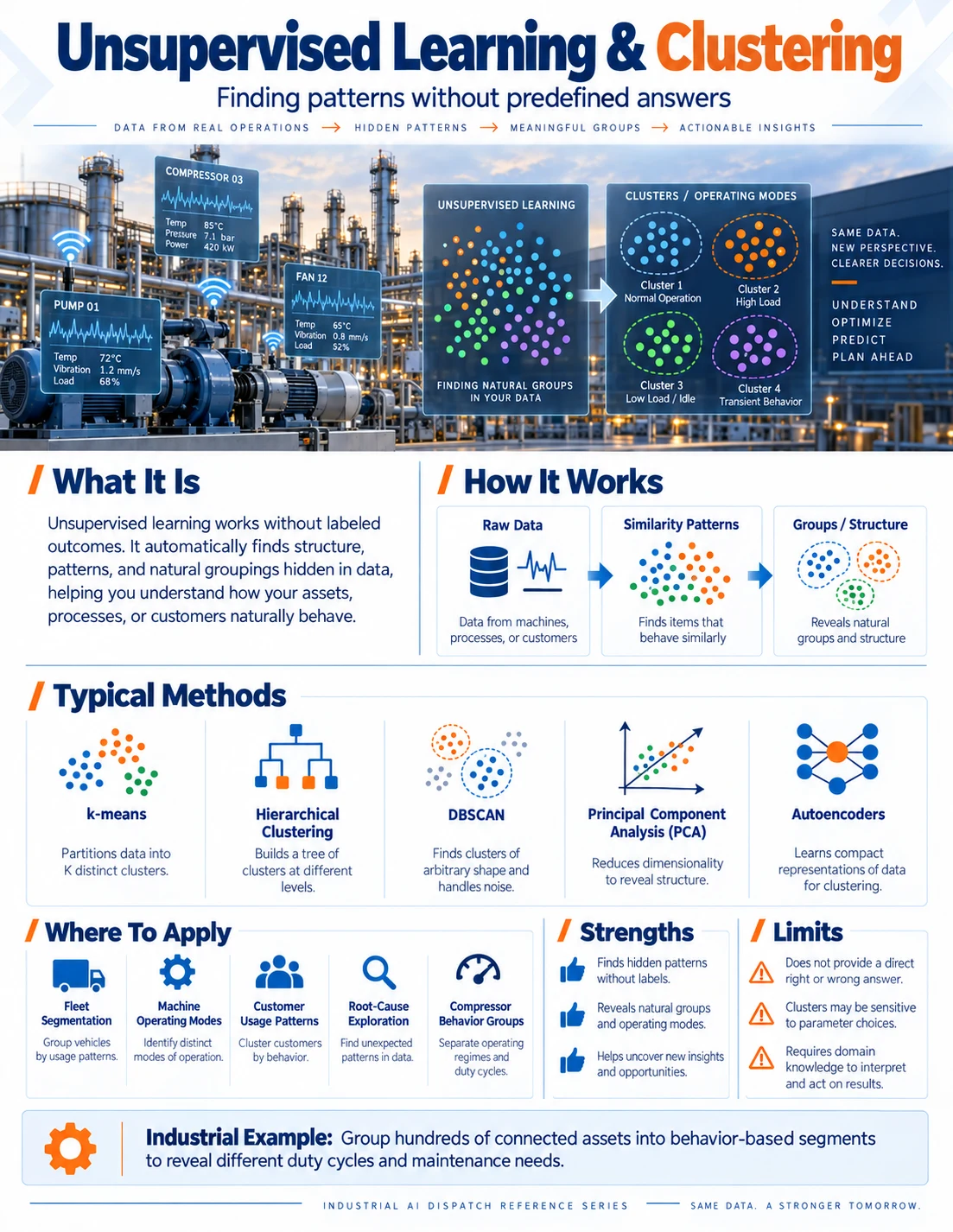
Overview
Unsupervised learning looks for structure in data without relying on labeled answers. Clustering is the most common industrial example: it groups similar assets, machines, sites, customers, or behaviors so teams can better understand what is happening.
How It Works
- Assemble a dataset of observations without requiring labels.
- Measure similarity between records based on the features.
- Use a clustering or dimensionality reduction method to reveal structure.
- Interpret the resulting groups or low-dimensional views using domain knowledge.
- Turn the discovered patterns into segmentation, monitoring, or further modeling actions.
Typical Algorithms or Techniques
- k-means
- Hierarchical Clustering
- DBSCAN
- Principal Component Analysis (PCA)
- Autoencoders
Industrial Applications
- Fleet segmentation
- Machine operating modes
- Customer usage patterns
- Root-cause exploration
- Compressor behavior groups
Industrial Example
Group hundreds of connected assets into behavior-based segments to reveal different duty cycles, maintenance needs, and usage regimes.
Illustrative scenario; performance depends on the data, operating conditions, and validation.
Strengths
- Finds hidden patterns when labels do not exist.
- Reveals natural operating modes and groups.
- Helpful for exploration, segmentation, and hypothesis generation.
Limitations
- No automatic notion of right or wrong answer.
- Results can depend heavily on parameter choices and feature scaling.
- Human interpretation is essential.
Frequently Asked Questions
What is unsupervised learning?
Unsupervised learning looks for patterns, structure, or groups in data without using labeled outcomes.
What is clustering used for?
Clustering groups similar observations together. In industry, that can reveal asset segments, operating modes, customer behavior, or root-cause patterns.
When should unsupervised learning be used?
Use it when labels do not exist or when you want to explore the data before building a supervised model.
Does unsupervised learning give a single correct answer?
Usually no. Results still need interpretation, domain knowledge, and business judgment.
Related Algorithms
Explore Industrial Applications
See how these technologies connect to physical assets in the Industrial Equipment Atlas, or follow the Daily Signal for industrial AI developments.