Machine Learning Foundations
Supervised Learning
Learning from labeled historical examples
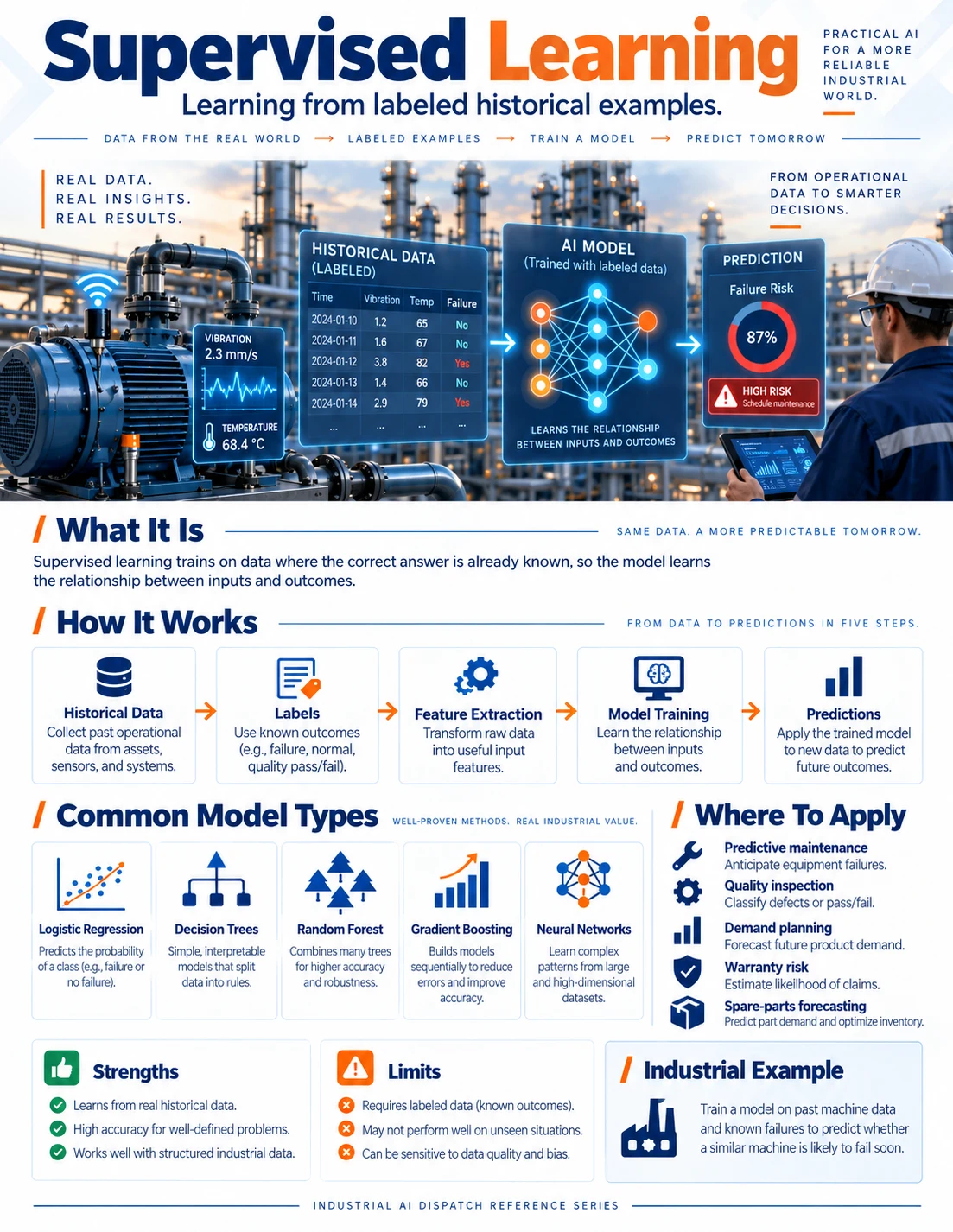
Overview
Supervised learning trains a model on examples where the correct answer is already known. In industrial settings, that usually means historical data paired with labels such as failure vs. no failure, defect vs. good part, or a target value such as remaining useful life.
How It Works
- Collect historical operational data from machines, processes, or transactions.
- Attach labels or outcomes to each record, such as “failure”, “normal”, “good part”, or a known target value.
- Transform raw data into useful features such as averages, rates of change, or engineered sensor indicators.
- Train a model to learn the relationship between inputs and outcomes.
- Apply the model to new data to generate predictions for future or unseen cases.
Typical Algorithms or Techniques
- Logistic Regression
- Decision Trees
- Random Forest
- Gradient Boosting
- Neural Networks
Industrial Applications
- Predictive maintenance
- Quality inspection
- Demand planning
- Warranty risk scoring
- Spare-parts forecasting
Industrial Example
Train a model on historical engine telemetry and service outcomes so it can predict whether a similar machine is likely to fail in the near future.
Illustrative scenario; performance depends on the data, operating conditions, and validation.
Strengths
- Learns from real historical evidence.
- Usually performs well on well-defined problems.
- Works with structured industrial data and supports measurable accuracy tracking.
Limitations
- Requires labeled training data.
- Can inherit bias or blind spots from the training set.
- May struggle when conditions change sharply from the past.
Frequently Asked Questions
What is supervised learning in industrial AI?
Supervised learning trains models on historical examples where the correct answer is already known. In industry, that often means sensor, maintenance, quality, or business data paired with outcomes such as failure, defect, demand, or remaining life.
When should supervised learning be used?
Use it when you have labeled historical data and a clear prediction target, such as pass/fail, likely breakdown, or expected output.
What is the difference between supervised and unsupervised learning?
Supervised learning uses known outcomes during training. Unsupervised learning does not use labels and instead looks for hidden structure, patterns, or groups in the data.
What are common industrial uses of supervised learning?
Common uses include predictive maintenance, quality inspection, warranty analytics, demand planning, and spare-parts forecasting.
Related Algorithms
Explore Industrial Applications
See how these technologies connect to physical assets in the Industrial Equipment Atlas, or follow the Daily Signal for industrial AI developments.