Language and Knowledge AI
Retrieval-Augmented Generation (RAG)
Combining language models with trusted enterprise knowledge
Overview
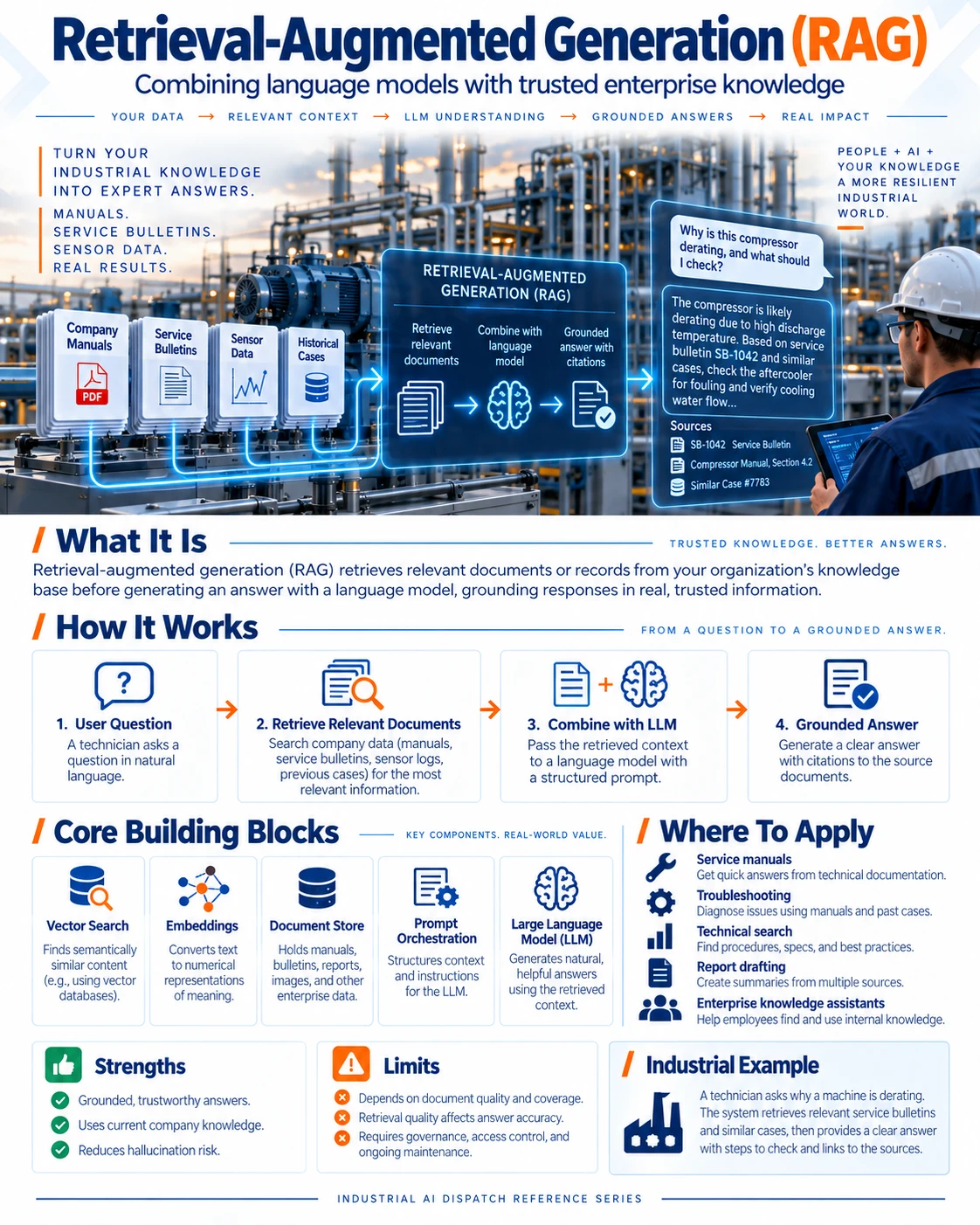
RAG improves language model answers by retrieving relevant company documents, records, bulletins, or logs before the answer is generated. That makes responses more grounded, more current, and more useful in industrial settings.
How It Works
- Accept a user question in natural language.
- Search a knowledge base for the most relevant content.
- Pass the retrieved context to a language model with a structured prompt.
- Generate an answer that uses the retrieved evidence.
- Present the response, ideally with source references or citations.
Typical Algorithms or Techniques
- Vector search
- Embeddings
- Document stores
- Prompt orchestration
- LLM answer generation
Industrial Applications
- Service-manual assistants
- Troubleshooting copilots
- Technical search
- Report drafting
- Enterprise knowledge assistants
Industrial Example
A technician asks why a compressor is derating. The system retrieves service bulletins, similar cases, and the relevant manual section before generating a grounded answer.
Illustrative scenario; performance depends on the data, operating conditions, and validation.
Strengths
- Grounds answers in company knowledge.
- Reduces hallucination risk compared with standalone LLMs.
- Works well for manuals, bulletins, procedures, and historical cases.
Limitations
- Depends on document quality and search relevance.
- Requires governance, permissions, and content maintenance.
- Still needs answer validation for critical workflows.
Frequently Asked Questions
What is RAG?
Retrieval-augmented generation combines a language model with document retrieval so answers are grounded in relevant source material.
How is RAG different from a plain LLM?
A plain LLM answers from its learned knowledge and prompt context, while RAG first retrieves relevant enterprise content and then uses that context to answer.
Where is RAG useful in industrial AI?
It is useful for service manuals, troubleshooting, technical search, report drafting, and enterprise knowledge assistants.
Does RAG eliminate hallucinations completely?
No. It usually reduces hallucination risk, but retrieval quality, source quality, and answer validation still matter.
Related Algorithms
Explore Industrial Applications
See how these technologies connect to physical assets in the Industrial Equipment Atlas, or follow the Daily Signal for industrial AI developments.